by Skip Via
skip@westvalleynaturalists.org
I love bees, so it’s always a treat to encounter a native species that is new to me. That was the case a couple of days ago with the Nevada Bumble Bee, when I first encountered several feeding on some creamy pea vine (vetch family) in Happy Valley and the next day on my back deck with her head deeply embedded in some petunias in some hanging flower baskets. They’re hard to miss–they’re very large (queens are nearly an inch long), have lots of dense yellow/orange fur on their thorax and abdomen, and their buzz is considerably louder than any other species I have encountered. Males and females are very similar except that the females and queens have black heads, whereas the males have yellow heads. That’s why I think the bee pictured below is a female, possibly a queen given her size.
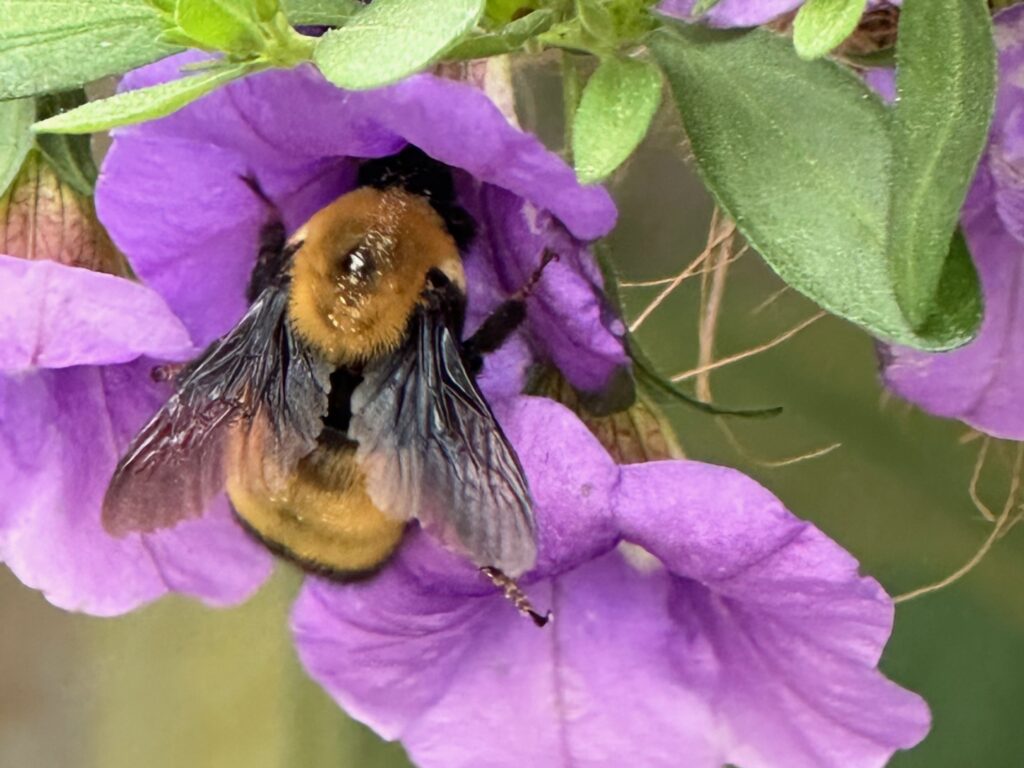
Given their commonality to the region, I’m surprised I have never seen one. At least, I’m not aware that I have ever seen one. It may be the case that I have seen workers, who are smaller (a bit more than 1/2 inch), but never a queen.
Nevada bumble bees are ground nesters. They feed on the nectar of vetches, thistles, bee balms, penstemons, salvia, lupines, and many others, making them important pollinators for our wildflowers. They are year ’round residents of Montana, but they are more common in Western Montana. They are found throughout the western US and as far north as British Columbia, Canada.
One identifying feature of the species is a bare black patch on the upper back. Males often have a bit of red at the tip of the abdomen.

I found a navada bee in my garden in Scotland…Milngavie to be exact
It was s female bee she couldnt fly..one wing didnt move
This were in june 2024.
I read up on bees where I provided safety in box I had lined it with hay and sawdust alongside blooms from wild flowers.
I also purchased bee fondant from Amazon to provide be necessary nutrition.
I noticed when I placed box in garden when sin out..Bee would favour to sit on flower on box enjoying the heat from sun.
At night took box indoors as heading towards autumn here
Sadly yesterday I noticed the bee had died.
Prior to over past weeks she had not been as active favouring to nest in her hay, and not feeding.
In total I had her 4 months..I actually got quite attached to my bee…
As i learned alot she gave me opportunity to do this.
That’s a lovely story, Alison. I did a little reading on life expectancies of bumble bees, and it sounds like yours had a longer than normal life span. If it was a female worker, it could live from 3 to 12 weeks in the wild. Queen bees can live over winter by hibernating, but they die in the spring after they have build their nests and laid their eggs, to be cared for by newly emerged females.
Wondering if you could help identify this. They are inhabiting a beautiful rd house in my deck.
Hi Nancy – A little difficult to tell from the photo, but given the time of year, I’m fairly certain that’s a Hunt’s bumblebee. The red/orange band on its abdomen is indicative. They’re early emergers in these parts—usually the first bumblebee I see when the weather turns warm enough.
I believe this bumble bee is a Nevada Bumble Bee. It was quite large with pollen sac(s). I just took this picture in my garden in Breckeridge,CO at 10,000 ft above sea level. VEry impressive bee.
I think you’re right, Susan. The “furry” shoulders, prominent black patch, and size (they’re BIG) are all identifiers. I’ve never heard of one at that altitude, but Colorado is well within their range. Great photo! Thanks for sharing.