by Skip Via
skip@westvalleynaturalists.org
Editor’s note: More details on what constitutes hoar frost, rime frost, and rime ice may be found in this article on our web site: Hoar Frost or Rime Ice, or Something else?
Click on images to enlarge them.
On December 30 and 31, 2025, the conditions in the West Valley were perfect for creating rime frost: low, dense fog, cold temperatures, and steady winds.
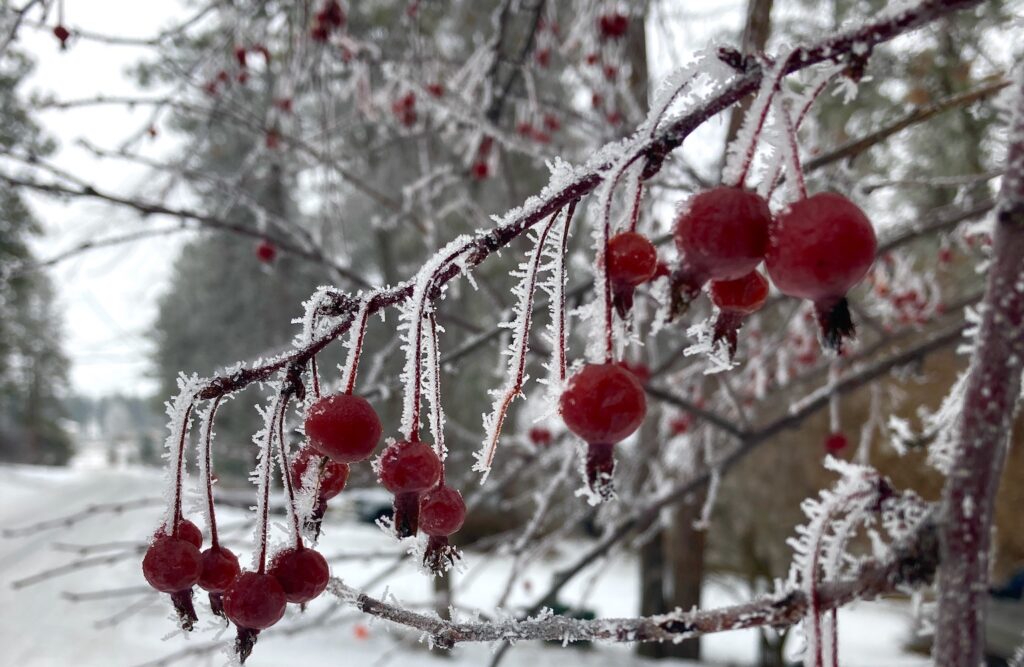
What is rime frost? Let’s begin by what it is not. Rime frost is not hoar frost. Hoar frost occurs under very specific conditions–clear, cold nights with high humidity and no wind. Water vapor in the still air condenses directly on cold surfaces, forming delicate ice crystals that can be clear or white, and needle-like or lacy in appearance. it will appear first on very thin surfaces of twigs, grasses, needles, fence wires etc., as these items lose their heat much more rapidly than thicker surfaces of trees, houses, fence posts, or other thicker objects. It can even form on snow or ice.

Note that the crystals covers all surfaces of the branches and leaves. (click to enlarge)
Hoar frost is ephemeral. The lightest wind or agitation will dislodge it from the surface on which it formed. As there is no wind when it formed, it will form on all surfaces that are cold enough, not just along the leeward side as is typical with rime frost.
Rime frost occurs on cold, foggy nights with light to strong winds. Supercooled water droplets from the fog freeze onto cold surfaces of objects large and small, although, like hoar frost, it will be noticed first on long, thin objects such as Ponderosa pine needles that have lost their heat quickly due to their high surface area to mass ratio. As more water droplets hit the cold surfaces, more rime frost forms.
Rime frost is white and typically feathery n appearance. It will also form in thicker masses that hoar frost.


The frost as formed on the leeward side of the wire, indicating the direction of the wind when it formed.
Editor’s note: Please refer to the comments about “leeward” and “windward” in the Comments section at the end of this article for a different perspective on how this phenomenon formed.
Unlike hoar frost, which typically disappears quickly due to wind, agitation, or warming temperatures, rime frost can stay around and build up over time as long as the conditions for its formation are favorable. This can be especially true along heavily traveled roadways, as moisture from automobile exhaust can act like fog under favorable conditions.
Whatever you call it, it makes for beautiful winter landscapes. Click on an image to enlarge it.


Could “leeward” in the wire and fence captions be “windward”? Rime usually builds up on the side facing the wind as supercooled droplets strike and freeze onto the object. The Met Office’s explanation of freezing fog makes that distinction, which matters if readers use the ice to infer wind direction: https://weather.metoffice.gov.uk/learn-about/weather/types-of-weather/fog . The comparison with hoar frost is particularly useful for interpreting these winter scenes.
You make a good point, and I’ll reference your comment in the article as a point of discussion. One issue I discovered in my query into what actually constitutes ice, rime, or frost is that not all sources agree on the usage of terms when describing these phenomena especially “across the pond.” The reference in your link suggests that rime forms along the windward side from supercooled water droplets from fog–in other words, facing the wind. But the evidence from the scenes that I photographed suggests that the frost that formed on the twigs and fences accumulated on the leeward side of the objects, away from the wind. So I’m going to do a little more research on this and see what I can come up with. I’m not disagreeing with your much appreciated comment. It’s more that I’m confused. :-).