by Skip Via
skip@westvalleynaturalists.org
Click on images to enlarge them.
Editor’s note: This article has been updated to include some information and images from Pat Jaquith,
Ghost pipe, which is known by many other names including ghost flower, corpse plant, and Indian pipe, may be found in the West Valley area. If you do run across any, please take a few photos and then leave it alone, for reasons that will be explained below.
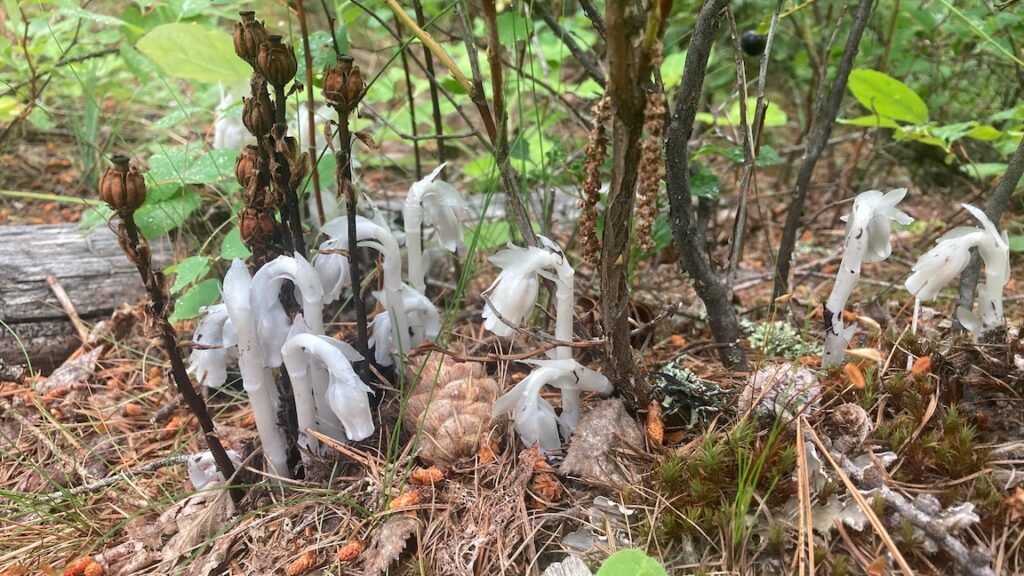
The scientific name for ghost pipe is Monotropa uniflora, the translation of which explains a lot about the plant. It has a single stem which bears a single flower. It’s almost always pure white, although there are some examples that have a few black markings and a very rare variant that is deep red. There are also some varieties, which can be found here in the Valley, that are distinctly pink. See below. In the next image,, some black markings are apparent, but I believe most of this is from decaying leaves or bracts on the flower and stems. Enlarge the photo and see what you think.


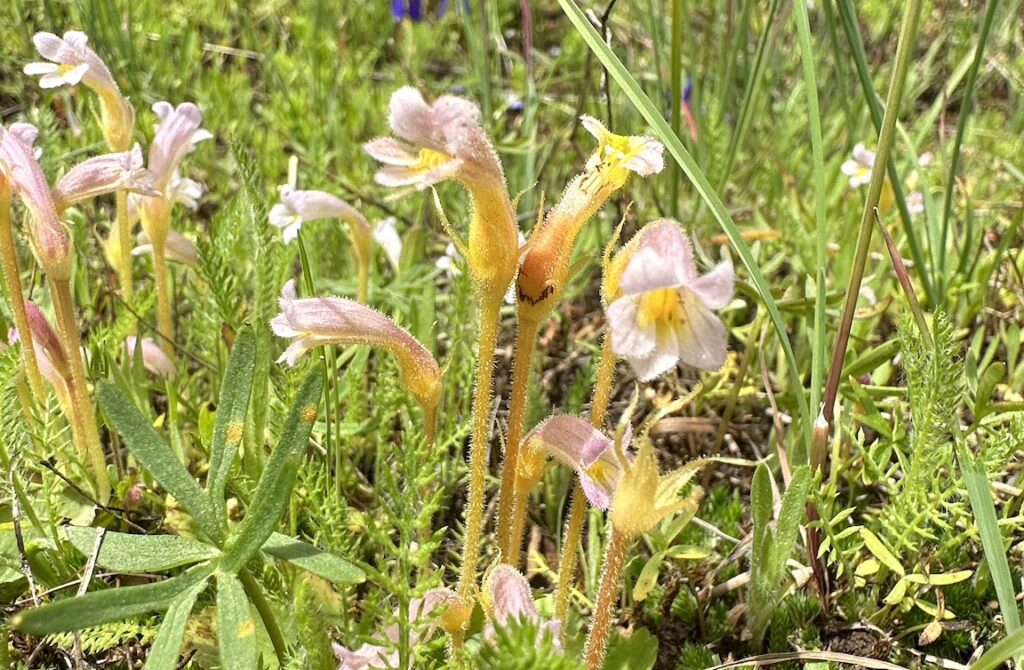
Ghost pipe closely resembles and is related to the unfortunately-named naked broomrape (Orobanche uniflora) but it is less common, especially in our area. Naked broomrape is sometimes called ghost pipe, but this is not entirely accurate.
Ghost pipe is white because it contains no chlorophyll. It doesn’t need sunlight to grow. Rather, it’s parasitic. It gets nutrients by attaching itself to the roots of photosynthetic trees–more specifically, to the places where a mycorrhizal fungus that grows symbiotically with the host tree attaches itself to the tree’s roots. In this way ghost pipe is able to siphon off some of the nutrients that are being exchanged between the fungus and the host tree.
Since ghost pipe does not need sunlight, it typically grows in dark places, usually in soil that is rich in decaying organic matter where the mycorrhizal fungus thrives. It’s rare to see a single plant–they typically grow in groups, although the groups tend to be small and widely separated. They can be found in temperate regions of North America, South America, and Asia. Because ghost pipe has such specific requirements for growth, its reproduction can be challenging.
Ghost pipes do require pollination to produce seeds, and most of that is provided by bumblebees going after the pollen that they produce.
But here’s the problem: Ghost pipe has been “discovered” by influencers on the internet for its reputed health benefits. Ghost pipe was once used by Native Americans to treat a variety of health conditions, including pain, fever, and epilepsy. That usage had fallen out of favor over time. However, modern day foragers and alternative health influencers are constantly advocating for the use of ghost pipe for an even greater range of benefits, largely without any proven grounding in science. My favorite quote comes from this article in the Washington Post: ” Ghost pipe is the bee’s knees for anxiety, panic attacks, insomnia, migraines, muscle spasms, and just all the things. It makes you feel very Zen and grounded.”
All the things…
Because of this, ghost pipe is being over-harvested and is in danger of disappearing from some areas altogether. So, be on the lookout for it on your next walk in the woods. It’s a beautiful plant. Take some photos–but not the plants.
