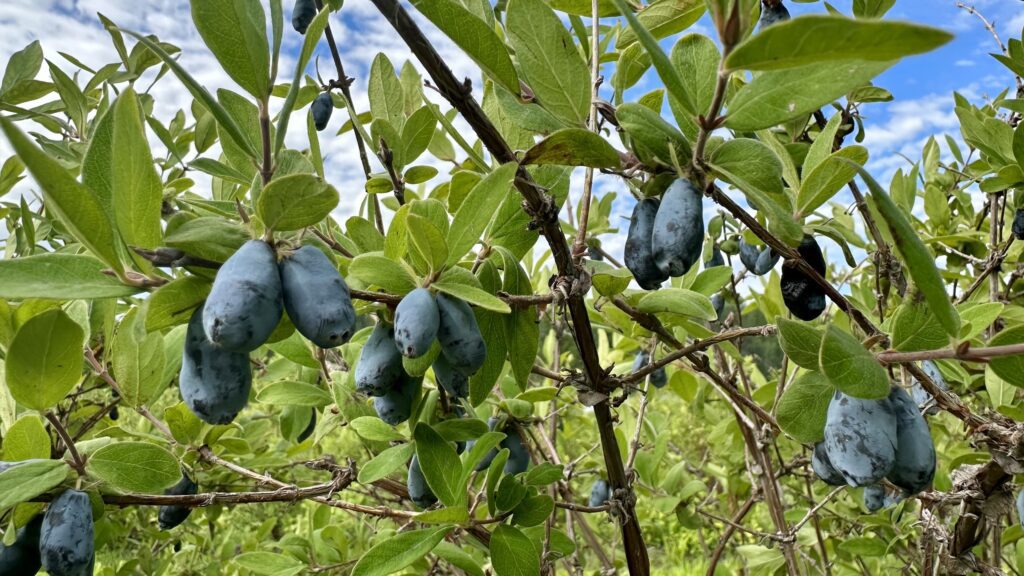
In northwest Montana, wild huckleberries rule the berry world. (Never mind that what we call huckleberries are not actually huckleberries at all, but rather a species of blueberry. I realize I could be shot for saying this.) But lately, another berry–this one cultivated–has been making its appearance in the West Valley area–honeyberries.
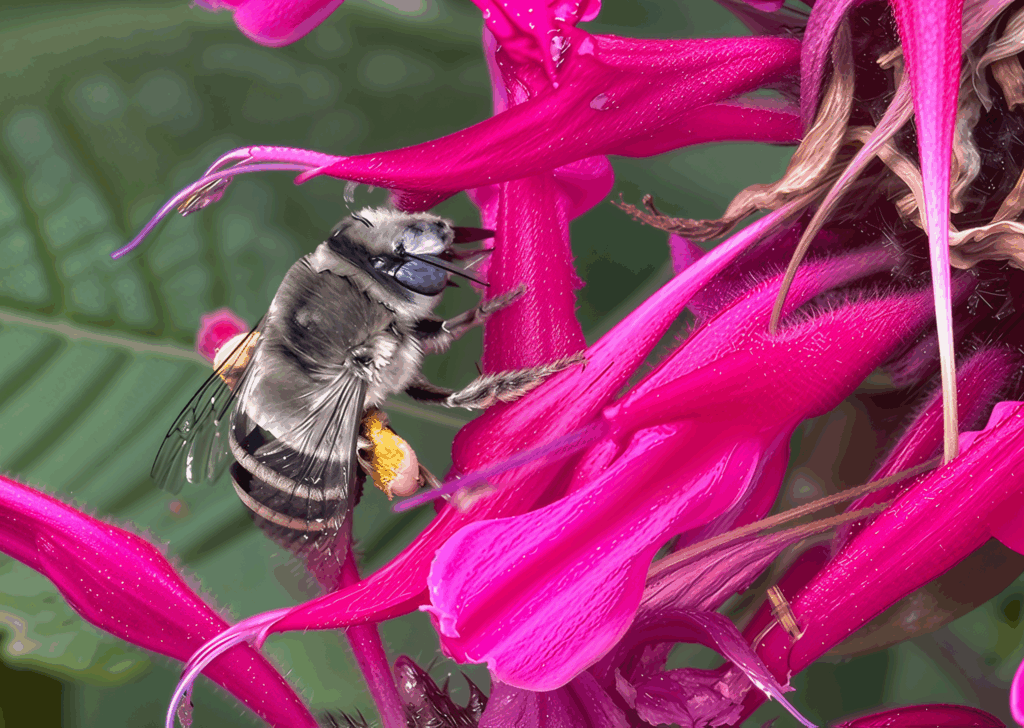
We have several beds of bee balm (bergamot), both native varieties and cultivars, planted around our property to attract bees and hummingbirds, which it does in huge numbers. It’s not uncommon find more than a dozen species of bees foraging for nectar on a single bed.
Lately, I’ve noticed a virtual invasion of a bee species that is new to me–a small, gray striped bee that looks like a cross between a honey bee and a bumblebee. True to form, it’s neither. It turns out that this is an urbane digger bee (Anthrophora urbana).
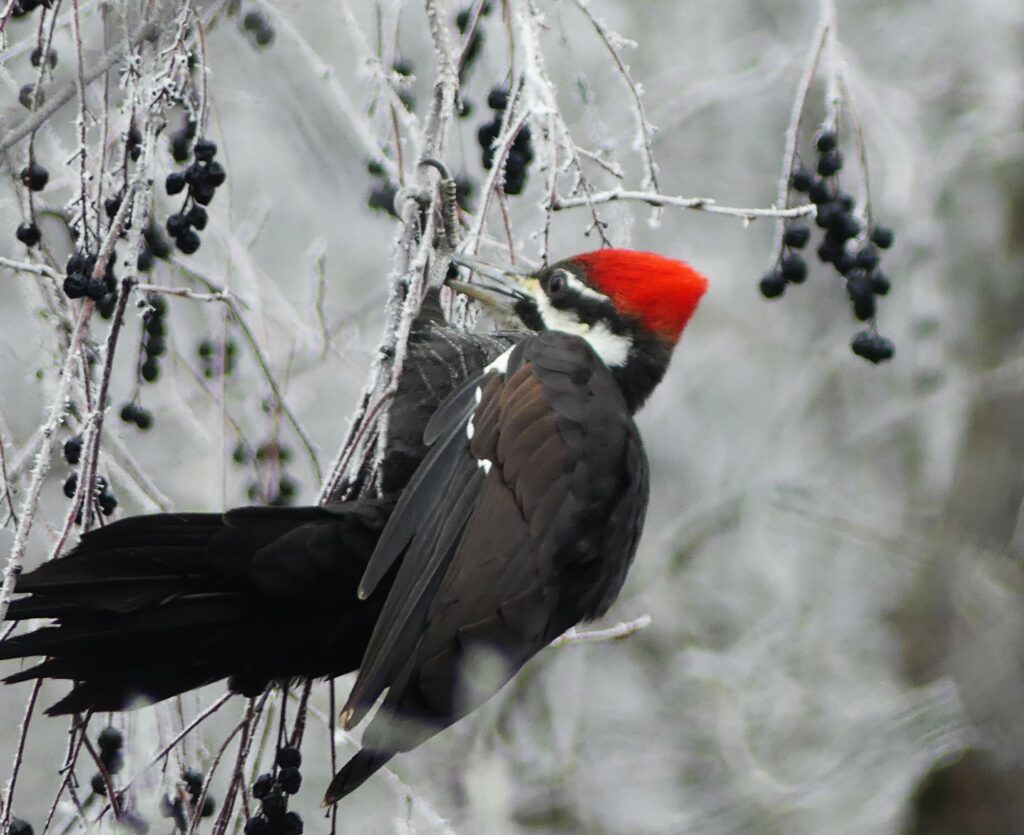
Pileated Woodpecker picking Common Buckthorn drupes 1.27.23
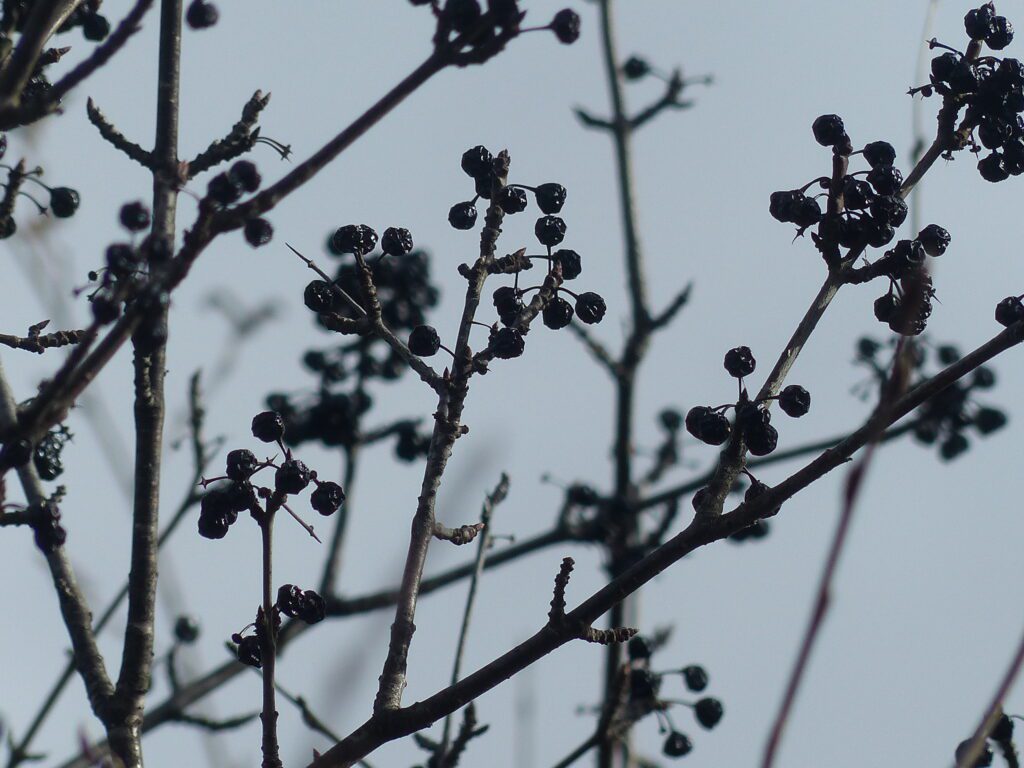
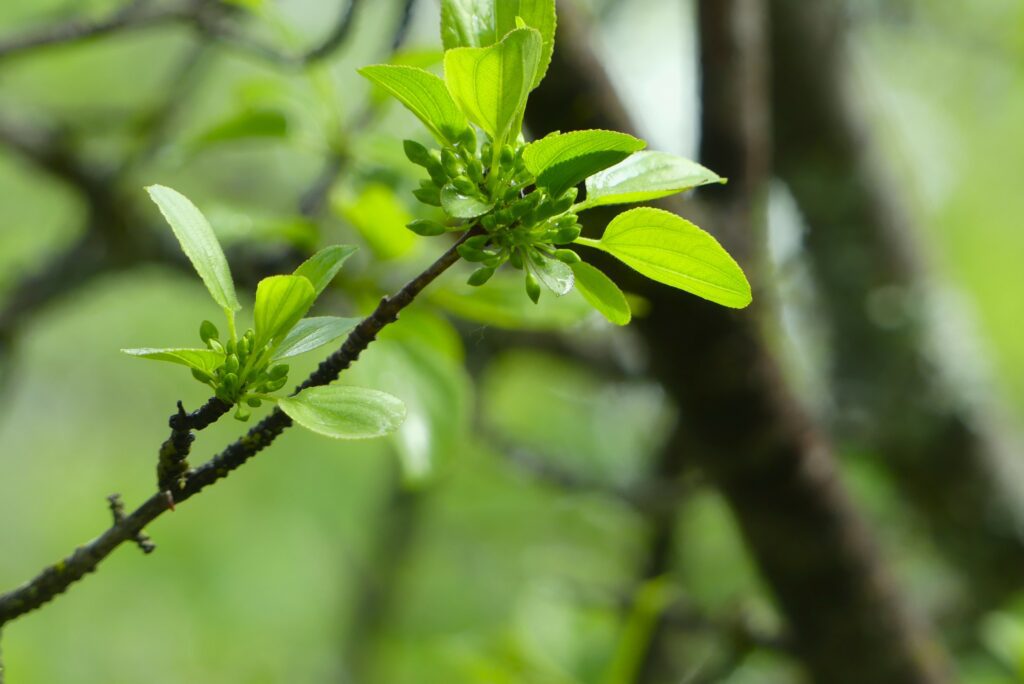
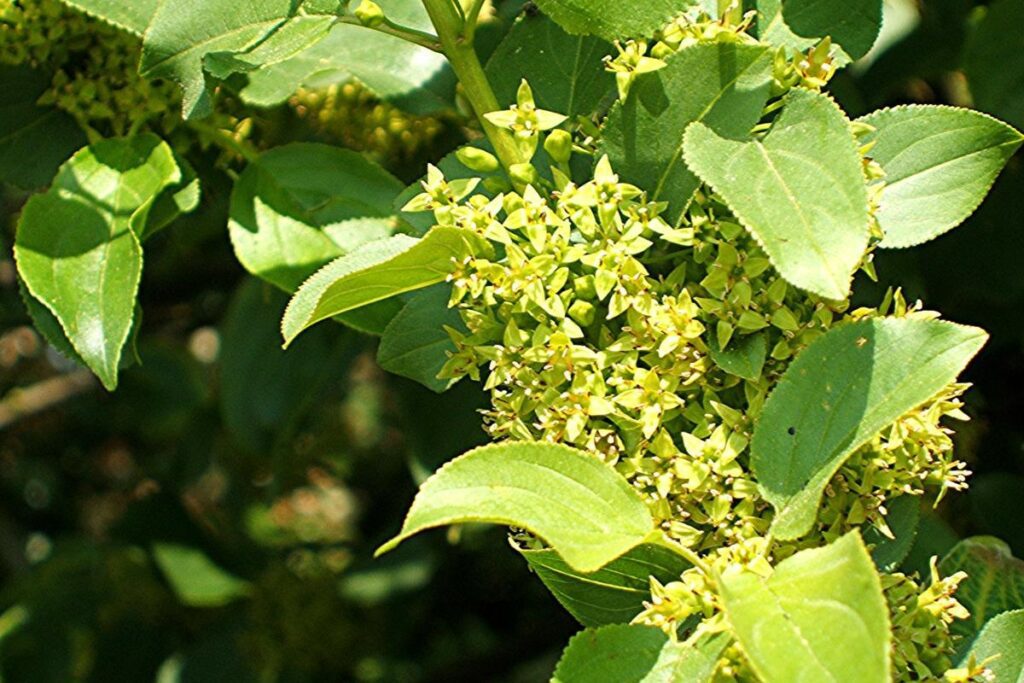
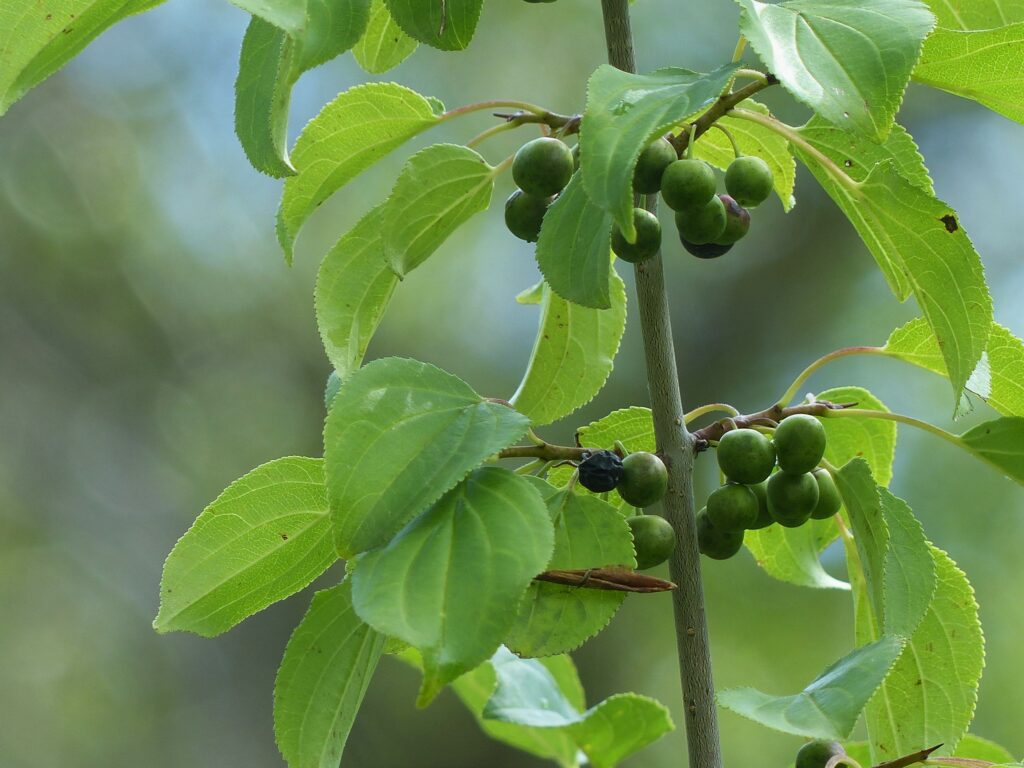
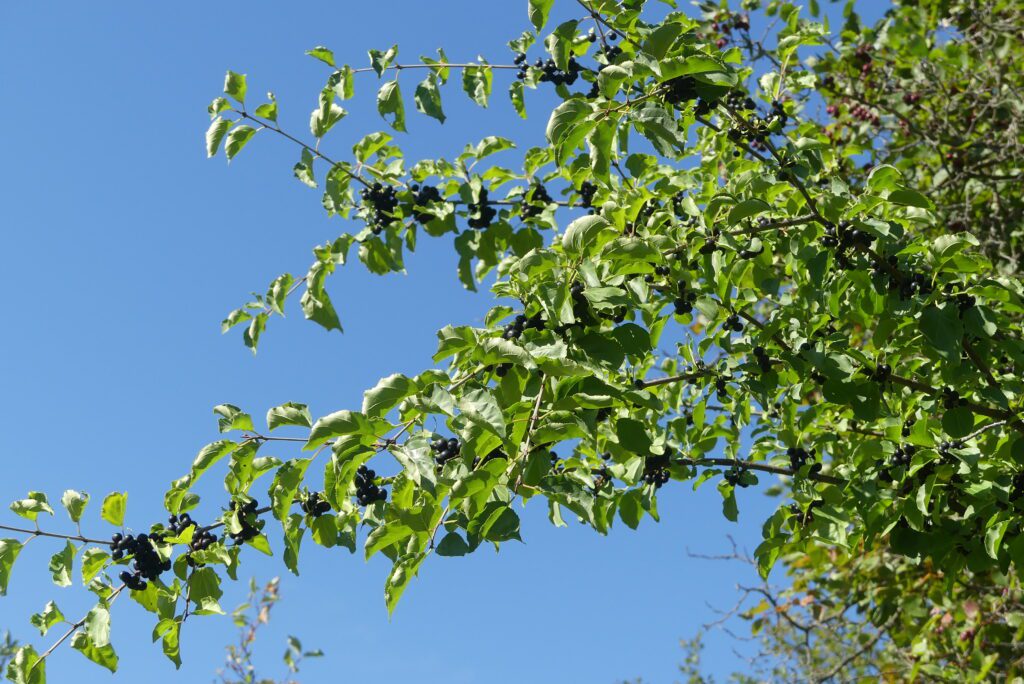
Common Buckthorn aka Rhamnus cathartica hides in plain sight. If you have walked in Lawrence Park or Owen Sowerwine in Kalispell or in many other areas along the local wetlands, you may have noticed the overwhelming prevalence of some shrub/trees that have thorns and lots of black fruits a little smaller than Chokecherries. The State of Montana recognizes this tree, native to Eurasia, as a Noxious Weed. It was introduced many years ago as an ornamental at a time when few people realized that many plants can be well-behaved in their native land because there are natural controls – insects or mammals that eat them and keep them in check or weather that checks their growth. However, in our country, none of those natural predators exist, and given time, the plant flourished to the extent that native plants are choked out. Cathartica refers to the fact that the plant (fruit) causes diarrhea. Birds are attracted to the fruits that ripen in late fall and persist throughout the winter. However, the birds gain no nutrition because of the catharsis it causes.
Bark of Common Buckthorn4.23 Drupes persistCedar Waxing feeding on dried drupes 4.26.22Common Buckthorn in bud 5.20.25Flowers May-JuneBranch with green drupes 8.23.199.07.23 Most Rhamnus cathartica drupes have 4 seedsEarly November, 2024
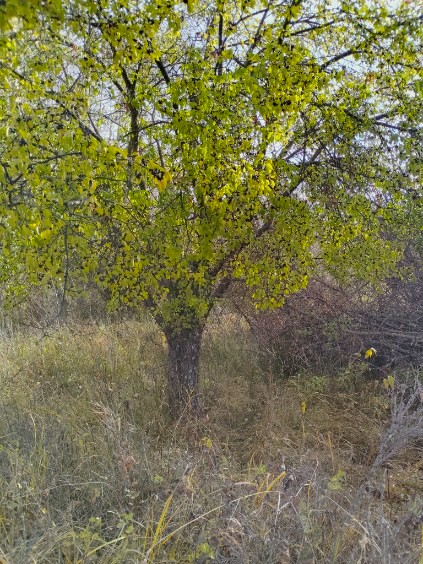
Bright yellow-green leaves haven’t dropped. When all the other deciduous trees have lost their leaves, this characteristic makes Common Buckthorn easy to identify.
Saplings no taller than 4′ and .5″ in diameter may have drupes. The tree above must be quite old.
If you have questions about identifying or controlling Noxious weeds, contact Your local Extension Service Your local weed control district Montana Department of Agriculture
Editor’s note: This article is a followup to this article from August 2024. The many uses of hemp are discussed in detail in that article.
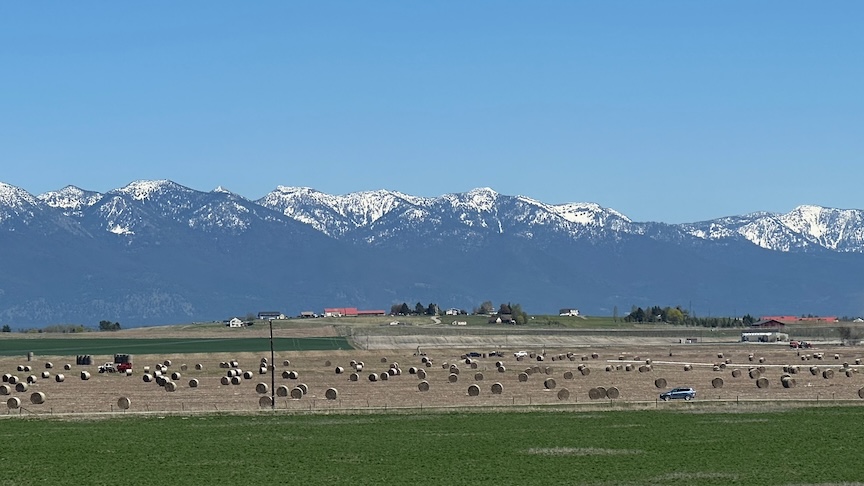
If you have driven down West Valley Drive north of West Reserve this spring, you have probably noticed the large number of hemp bales in the fields on either side of the road near the intersection with Coclet.. There are only two hemp growers in the valley and this operation of about 400 acres total between the two fields is one of them.
Editor’s Note: The smaller images on this page my be enlarged by clicking on them.
Part I focuses on some of the local birds that raise their offspring in cavities, that is, holes in trees, man-made house-like structures, and holes in earthen areas. Part II will cover some of the birds I have discovered raising their young in more exposed locations. I marvel at their ability to overcome the challenges that weather, predators, and life with dependents without physical barriers must present.
A Western Wood-Pewee fashioned a nest of grass, rootlets and bits of other natural material on a lichen-covered limb of a Douglas fir tree. There are many needle-laden branches overhead that provide shade and divert rain drops. When she returns to the nest, she always lands on a different branch and little by little approaches the nest site as if she doesn’t want to reveal the location to others. I had the unique opportunity to observe all of this in reverse. I was in the area to visit a plant I was studying. As I cast my gaze around the location so I could note landmarks to help me return, I noted “something looks different about this branch.” Indeed, the lump overhead looked like a little nest! At first, I wondered if the nest had overwintered. It was a few feet higher than I could reach, so I only could observe, not touch. As I continued to look up, movement caught my attention: it was the owner of the nest, intent on getting to the empty nest. I froze in place and before I could blink, the bird arrived. I paused just close enough to get a couple of pictures before abandoning the area. I returned several times that summer to monitor the plant; I’d look to see if the bird was on the nest before getting close, but finding the well-camouflaged nest was never easy.
Editor’s Note: The smaller images on this page may be enlarged by clicking on them.
Beautiful West Valley is the chosen home of many species of birds thanks to the varied agricultural uses, ponds and wetlands, and forested areas. Locating an appropriate homesite and constructing a new nest every year must be a daunting task for animals with a beak and two wings as principal tools! Observing birds making nests and raising their families every spring is a delightful time of discovery for me. In the following pages, I will share some of the avian nesting activities I have been fortunate to observe in our area.
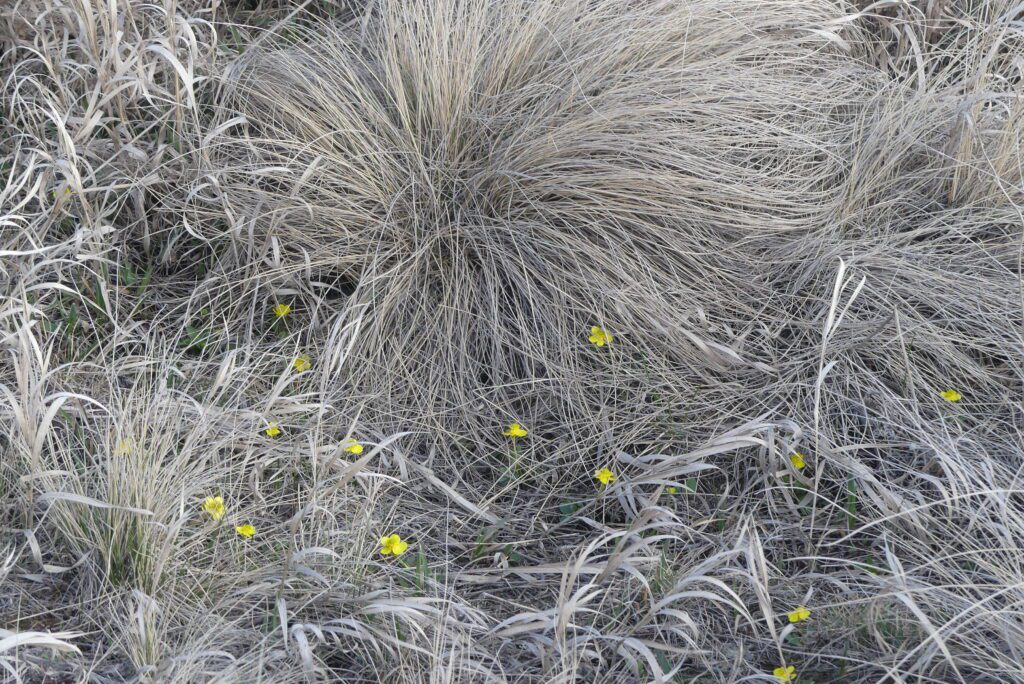
Like a bird incubating eggs, Bunchgrass growing on sunny hilltops protects and warms the ground for many ephemerals like Ranunculus glaberrimus.
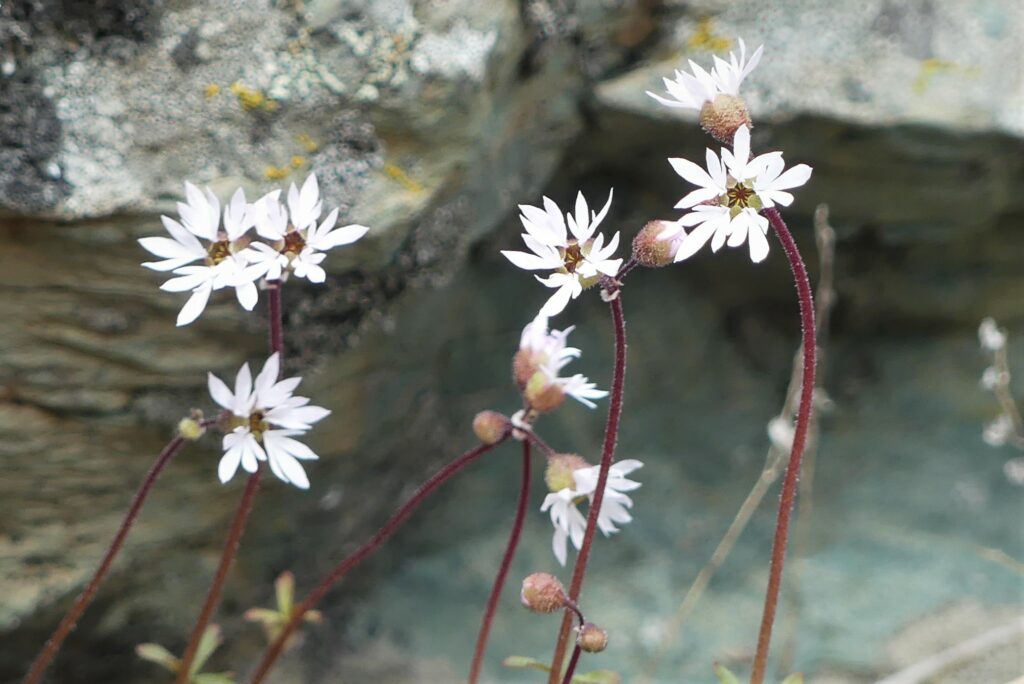
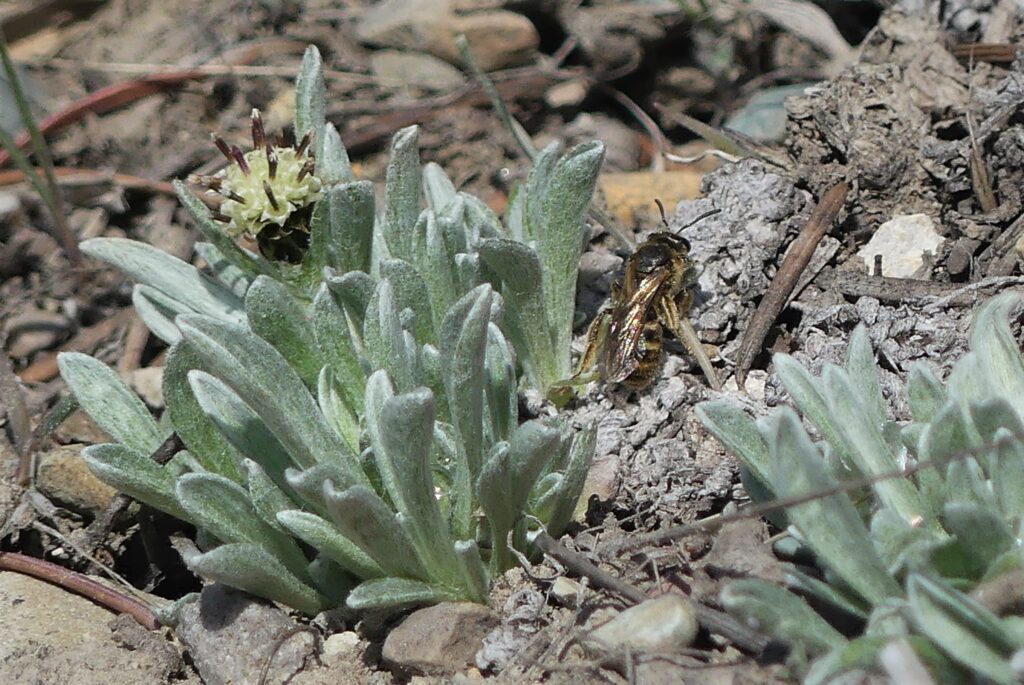
Lithophragma parviflora (Little Woodland Star) and Antennaria dimorpha (Cushion Pussytoes) often appear very early in sheltered areas warmed by west-facing stony outcrops. Tachinid flies are early-appearing pollinators of these flowers.
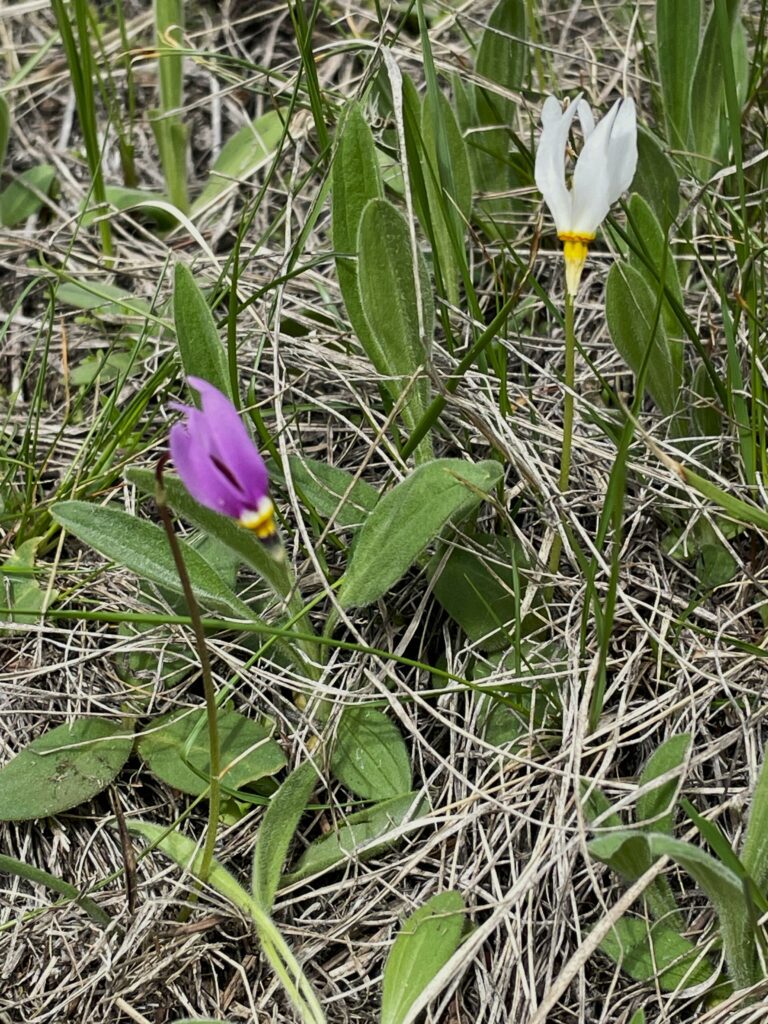
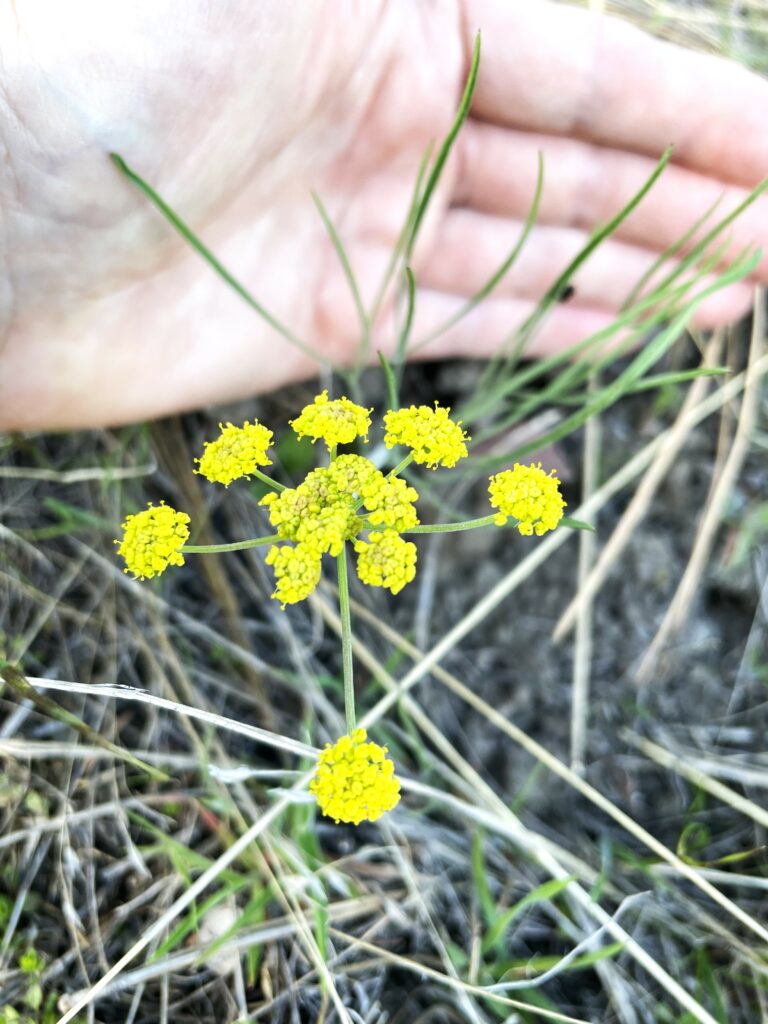
Dodecatheon conjugens (Shooting Star) and Lomatium triternatum (Nine-leaf Desert Parsley grow in an old pasture where grass will be two feet tall in another month.
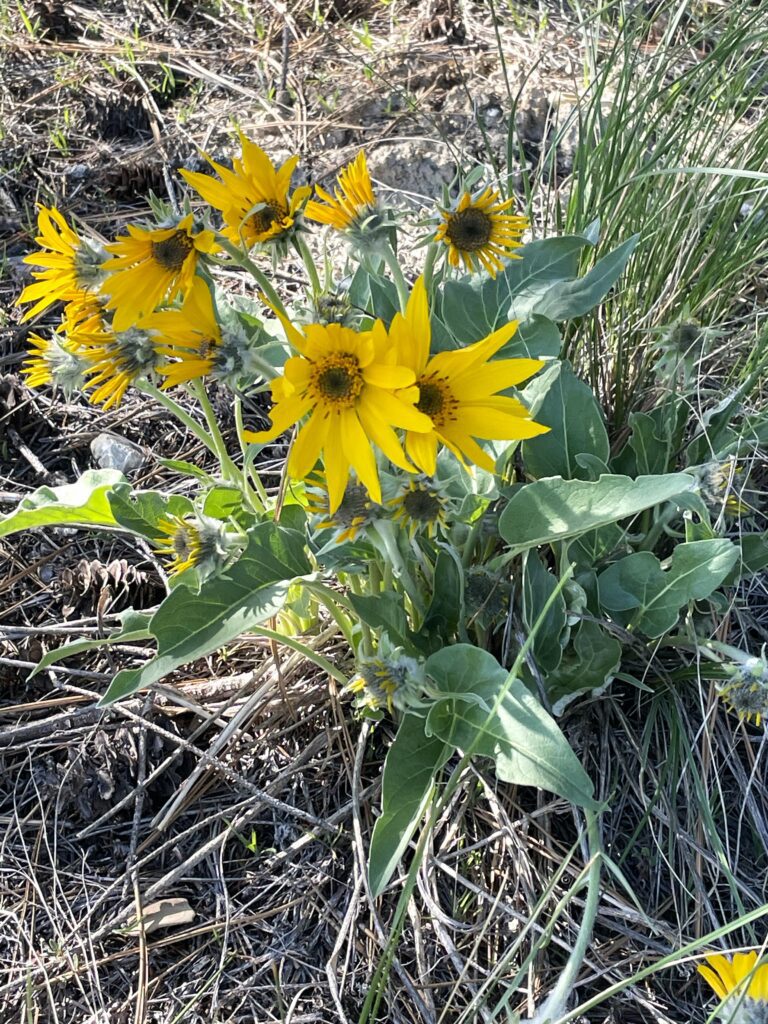
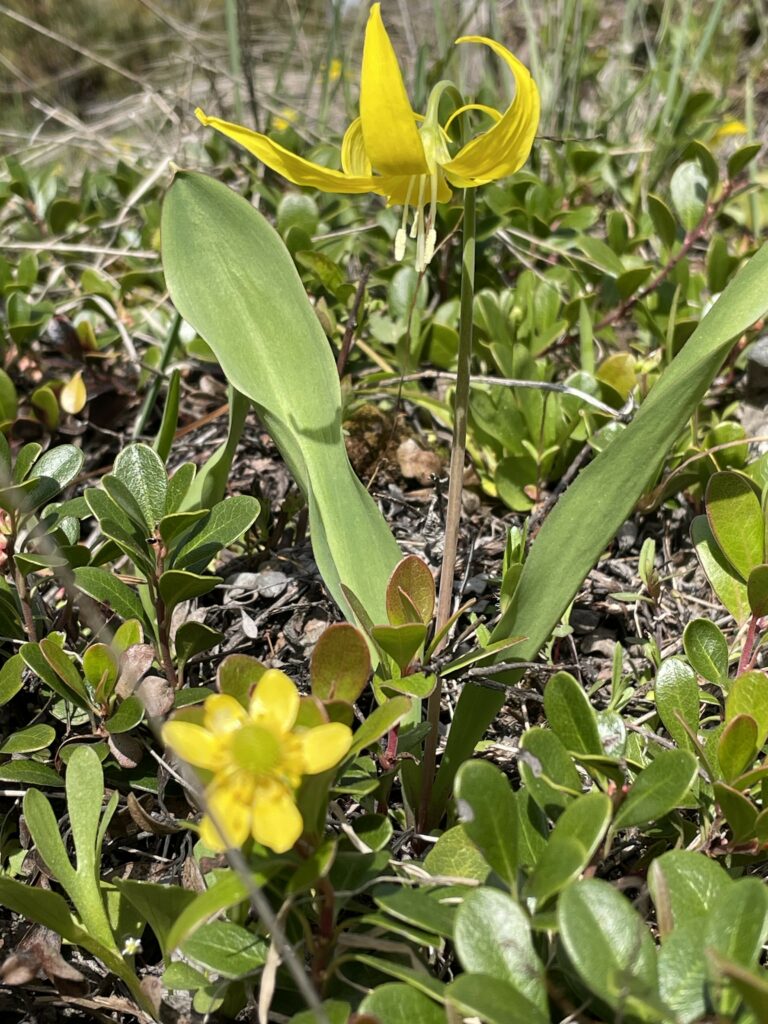
Balsamorhiza sagittata (Arrowleaf Balsamroot) Ranunculus glaberrimus (Early Buttercup) and Erythronium grandiflorum (Glacier Lily) are so precocious that sometimes they get covered with snow while in full flower and recover as if they had welcomed the extra gift of water.
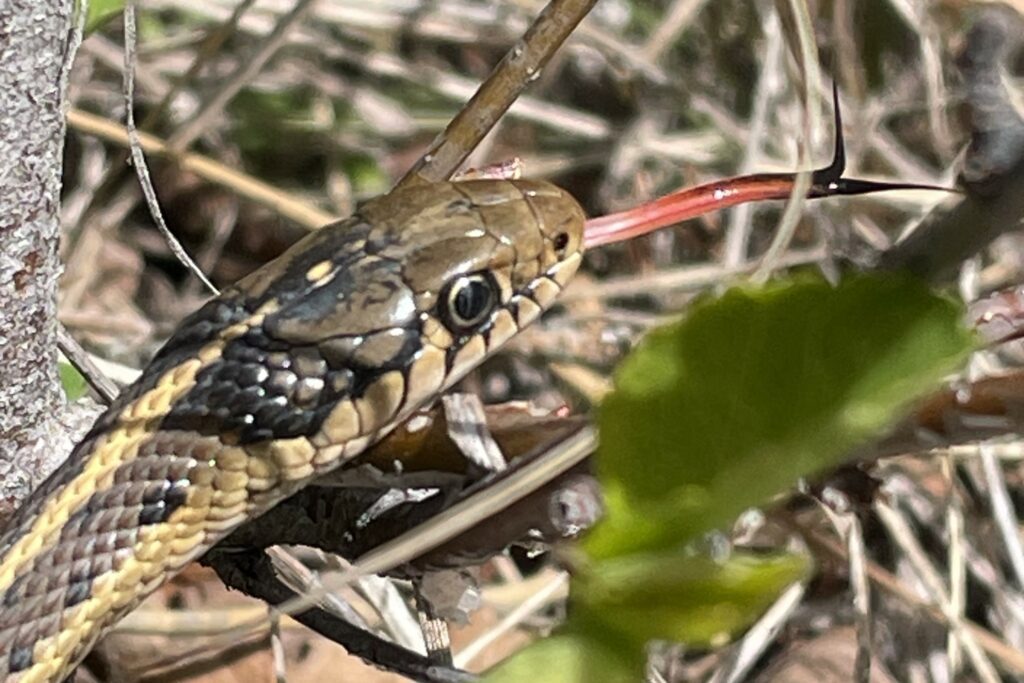
Oops! One of those surprises you can get while looking at the ground in search of early flowers! Recently emerged from hibernation, this garter snake was coiled around the stems of a young Serviceberry shrub in a sunny patch of soon-to-open Early Buttercups!
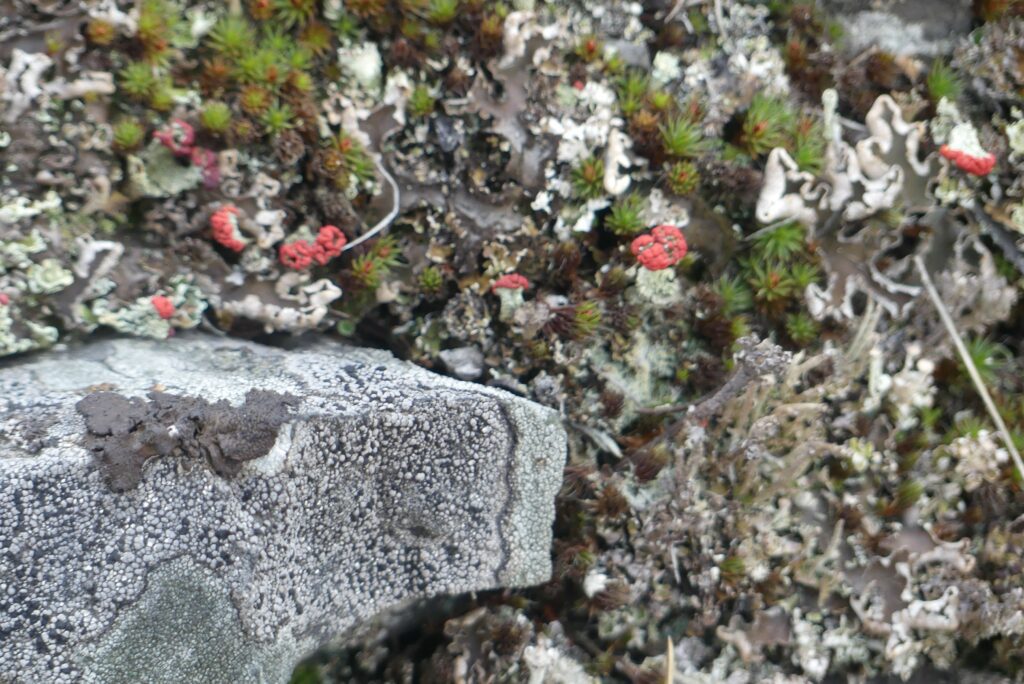
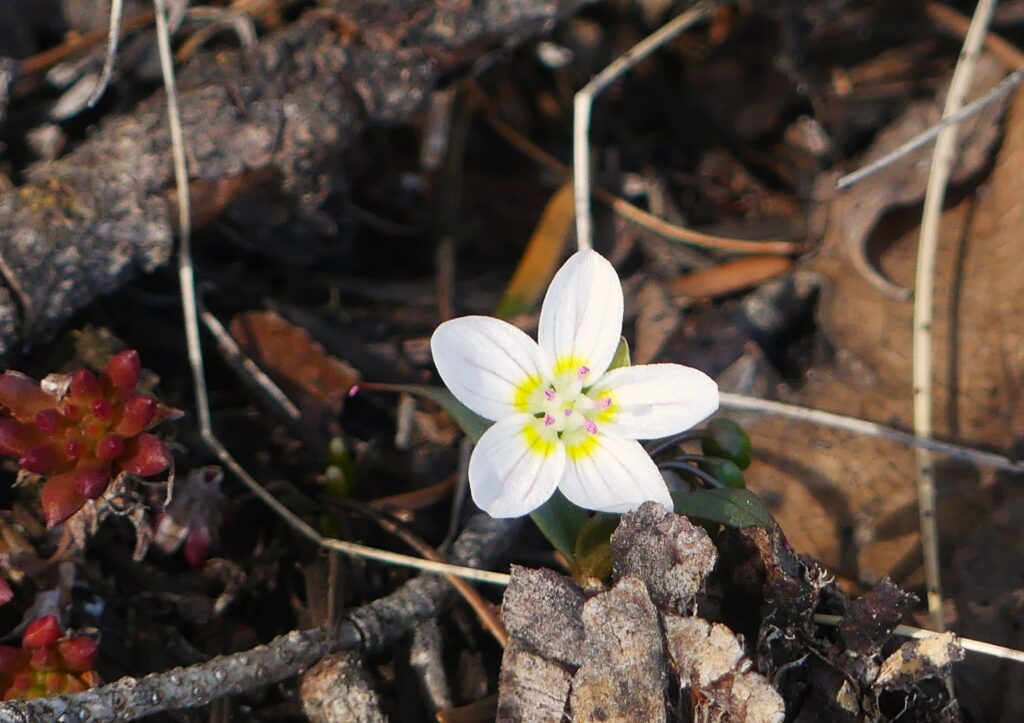
Cladonia pleurota (Red fruit Pixie cup lichen) Claytonia lanceolata (Spring Beauty)
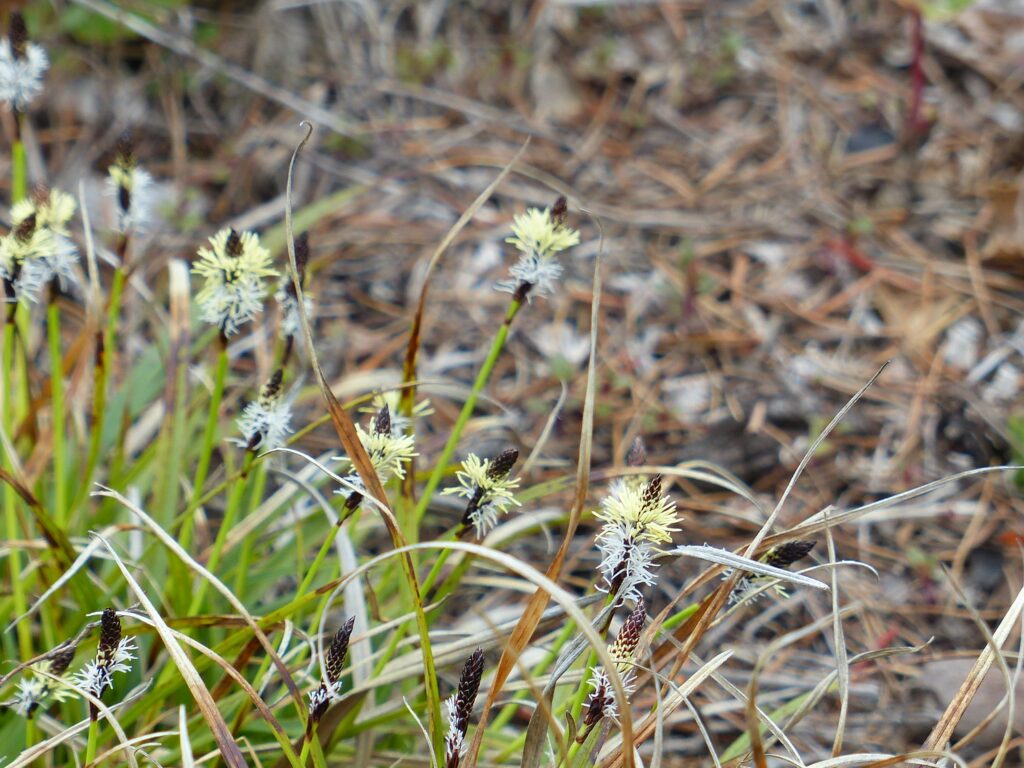
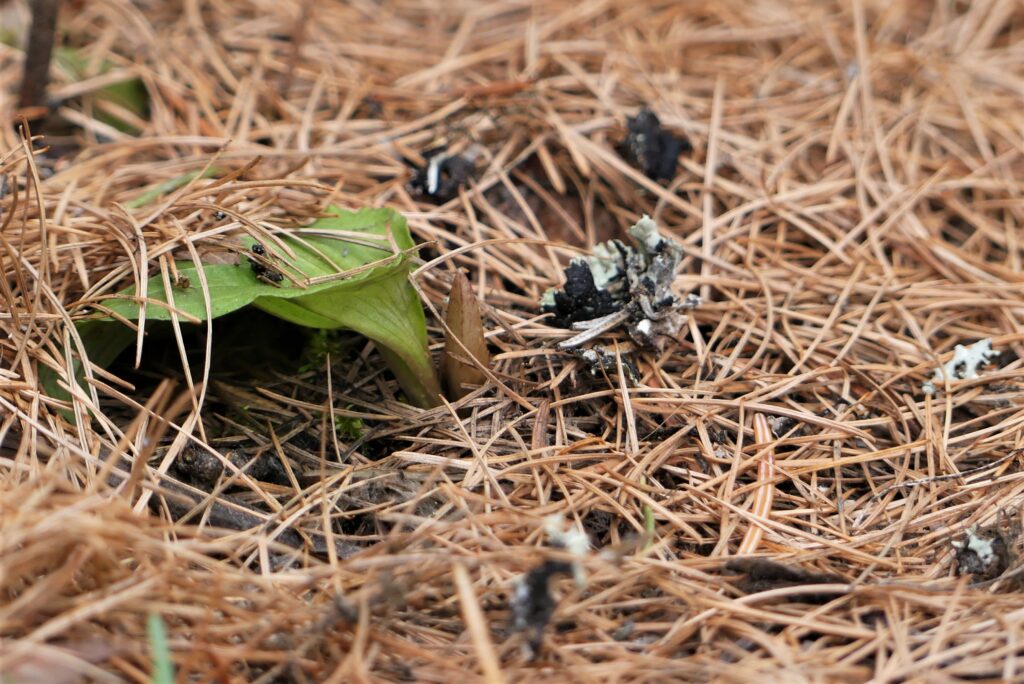
Carex concinnoides (Northwestern Sedge) and a wonderful discovery of the first appearance of a Calypso bulbosa(Fairy slipper orchid) plant, a little plant that will blossom in May!
There’s a bite of cold in that wind and snow on the mountains. Back roads slip from ice to mud in a single step. Winter visitors wing over snow-bent grasses as if to say “Farewell!” and Pintails fill the open water still enclosed by ice. FOY (First-of-the-Year) birds, flowers, songs meet with excitement. In sheltered places, the sun warms the ground and our faces. Let’s check it out!
I count cranes, specifically on six sections of grain and hay fields and ponds in the west valley. I go every day, late morning, 365 days a year unless I’m gone. Some people go to the gym, some for coffee with friends, some go to work. (More images of Dick’s photography are viewable on this companion article on our web site.)
Editor’s Note: This gallery of Dick’s extraordinary photography is a companion piece to Dick’s critically important post Bird Flu in West Valley. We are grateful to Dick for allowing us to publish these images on our site. You can find many more at walkerphotography.smugmug.com.
Editor’s Note: This is a followup story to The Ashley Creek Ditch, originally published here in February 2023. That article tells the story of the establishment of the irrigation ditch and its importance to valley farmers and families in the early 1900s.
The original Ashley Creek Ditch is no longer in existence as a contiguous waterway. Most of the ditch has been plowed under, paved, built on, or otherwise reclaimed from its original purpose. But there are a couple of remnants of the waterway still around. Pat Jaquith (with permission of the current property owners) was able to locate some sections and take a few photos. We are not disclosing the exact location of the ditch as parts of it are on private property.
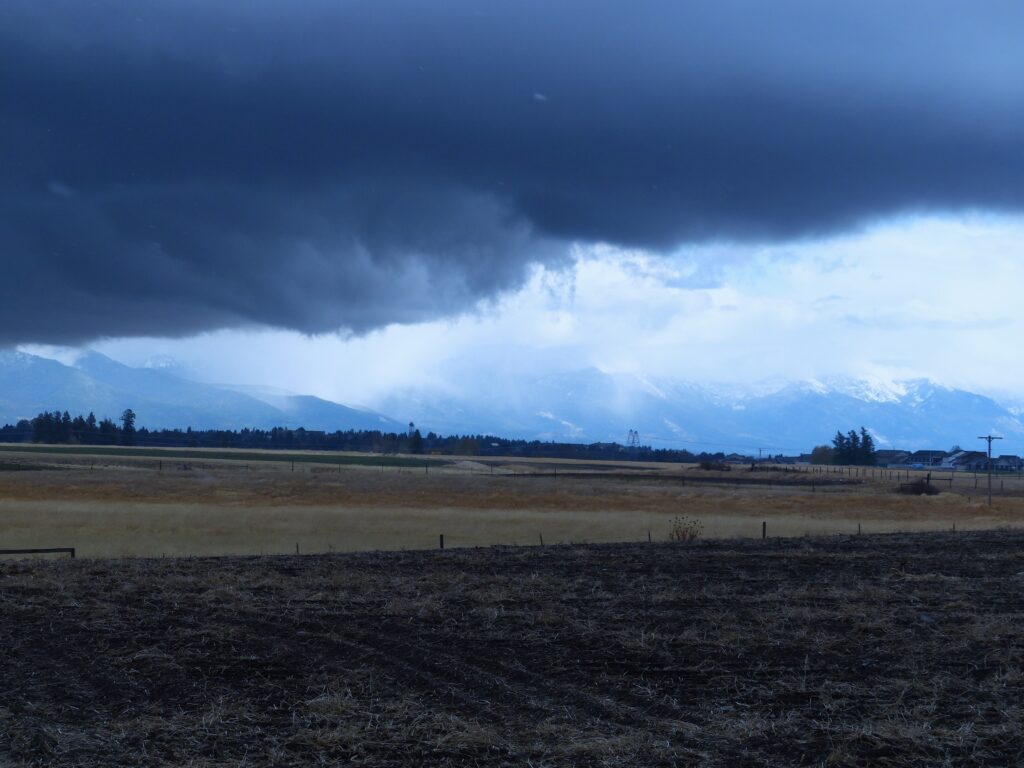
October 21, 2020 1:16 p.m. As I drove along West Valley Drive, the sun made a quick exit behind dark clouds, and I made a turn toward the ponds along Clark Road and West Springcreek Road to observe the dramatic change.
Hemp field on the corner of Coclet and West Valley Drive.
If you have driven down West Valley Drive this summer, you have probably noticed a new agricultural crop growing in a couple of the fields near Coclet. It’s hemp, and I wanted to know more about it.
Editor’s Note: Three days after this post was written, Montana FWP announced an “unprecedented” fishery closure (“hoot owl restrictions”) on the North Fork of the Flathead River due to record high water temperatures and rapidly decreasing stream flow in the absence of any meaningful precipitation this summer.
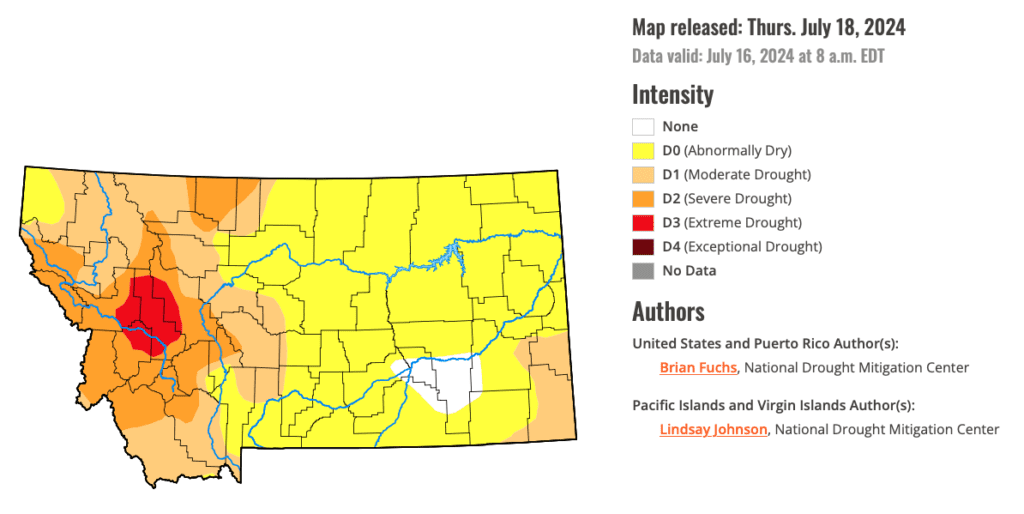
A year ago, when most of the valley was in the throes of an extreme drought, I posted an article titled Hydrology Snapshot, July 2023 in which I started the process of keeping track of some issues related to water usage, precipitation, and water management in the Flathead Valley.
It’s now mid-July 2024. We’re still experiencing drought conditions, but the severity has been downgraded to moderate/severe. Droughts are rated on a 5 point scale: D0 (Abnormally dry), D1 (Moderate), D2 (Severe), D3 (Extreme), and D4 (Exceptional). 99.62% of the Flathead is considered to be in Moderate (D1) conditions as of this writing.
English Inquiry Project by Sawyer S., West Valley School
What is a pollinator and what positive effects do they have on us humans?
What is a pollinator? This is something one may ask themself but not truly know. A pollinator is anything that carries pollen from the stamen to the stigma. This transfer must happen for the plant to produce. From squash to wheat, this is necessary for production. When someone says pollinator, one generally thinks of bees but this is not always the case. Pollinators include wind, water, bees, wasps, moths, butterflies, birds, and even small mammals including bats.