Hoar Frost or Rime Ice, or Something Else?

by Skip Via
skip@westvalleynaturalists.org

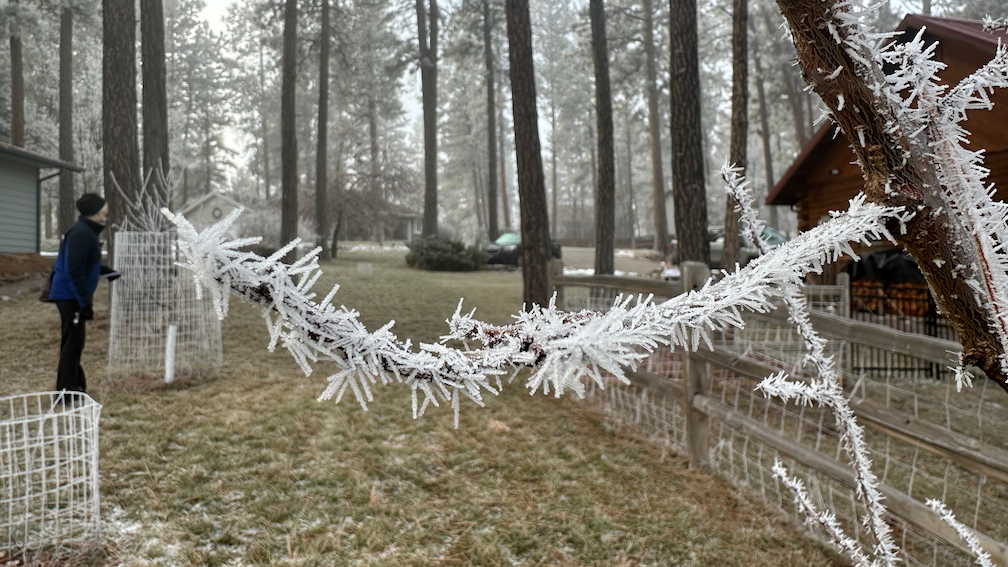
I woke up on December 29, after two days of dense fog, to see everything–leaves, grasses, fencing wire, pine needles–coated in a beautiful layer of hoar frost.

But wait…hoar frost occurs only in very specific conditions: namely cold, clear, and windless nights with low humidity, when the rapid radiant heat loss from surfaces causes water vapor–not liquid water droplets, as in fog–to form delicate, needle-like crystals on those surfaces. The previous two nights had been anything but cloudless with low humidity. You could feel the cold fog droplets on your face when you walked.

But it sure LOOKS like hoar frost. What’s going on here?

Continue Reading →

Are We Drying Up?

by Skip Via
skip@westvalleynaturalists.org

Editor’s note: In an earlier post on our website (Water Water Everywhere?) I discussed the nature of our valley water resources. Our groundwater comes from two sources–the shallow, unconfined aquifers that are replenished by precipitation, and the deeper confined aquifer from which Kalispell’s municipal water and most of the water used for irrigation in the valley is drawn. None of our water comes from reservoirs. (Whitefish gets its municipal water from Whitefish Lake.) A review of that article might provide good context for this article.

The intent of this article is intended to stimulate thought, not to advocate for a specific viewpoint. To that end, some assumptions, disclaimers and caveats:

  • I’m not a hydrologist, climatologist, or a geologist–just an interested observer;
  • Weather can change quickly in these parts;
  • Weather and climate are not the same thing;
  • I don’t know the answers to the questions I am posing.

It’s not difficult to see what a critical force water has been in the geographical and habitation history of our valley. If we didn’t have access to abundant water resources, both above and below ground, we would not be the agricultural center that we are now. And if it weren’t for glaciers, snowpack, and rushing rivers and streams, the landscape around here would look a lot different. There probably wouldn’t even be a place level enough with sufficient soil to farm at all.

Continue Reading →
Hydrology Snapshot, July 2023

by Skip Via
skip@westvalleynaturalists.org

My intention with this post is to begin a regular documentation of the local effects that hydrological issues have on life here in the valley.

This post from last month–Water Water Everywhere?–discusses some of the hydrological factors involved in how we access water resources for drinking and agriculture here in the valley, including a discussion of the water table and the Deep Aquifer, from which most of our water is drawn. The distinction between the water table and the Deep Aquifer is important. Rainfall, which can alter the local water table either by its presence or absence, does not affect the amount of water in the Deep Aquifer. Please refer to that article for more information.

Here’s a quick Flathead Valley hydrology snapshot from July 4, 2023:

Rainfall YTD5” (avg 9.72”)
Flathead Lake Level12” below 23-year median,
9” below full pool
Valley Sreamflow60% below average
Snowpack86% of average
SnowmeltFastest in 30 years
Continue Reading →

Hoarfrost or Rime Ice?

by Skip Via
skip@westvalleynaturalists.org

A few days ago, driving around West Valley, I remarked on the beauty of the hoarfrost that had coated some Ponderosa pines along the roadside. That got me wondering about the nature of hoarfrost and how it forms. It turns out that some of what I have been calling hoarfrost is, in fact, not hoarfrost, but rather rime ice. The difference is not important for the casual observer, but it can be important meteorologically.

Continue Reading →