by Skip Via
skip@westvalleynaturalists.org
Click on images to enlarge them.
Editor’s note: This post was edited on June 22, 2026, to include additional information about crepuscular rays, along with some minor editing.
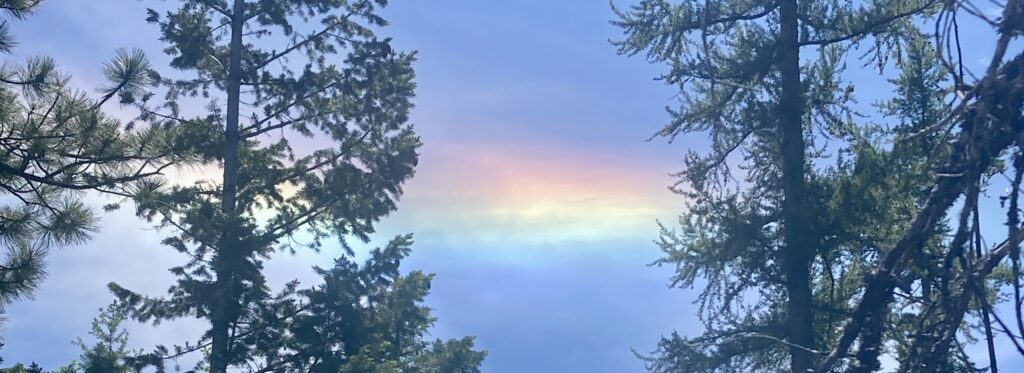
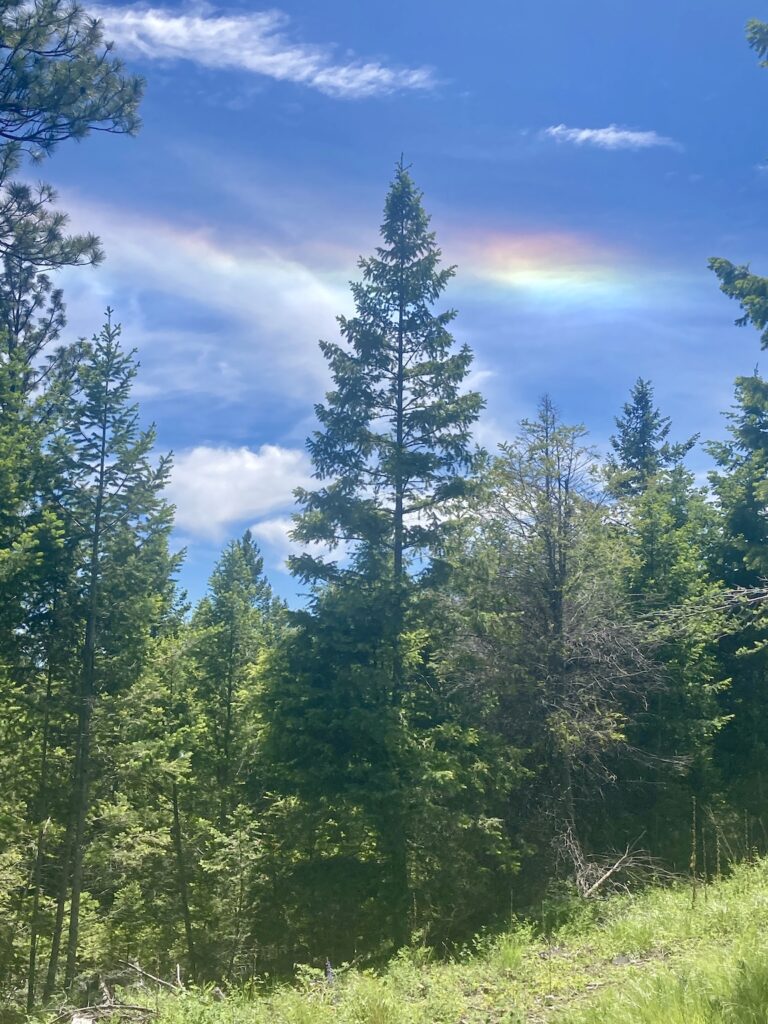
If you were gazing at the southeastern sky on the early afternoon of June 14, you may have noticed what appeared to be a rogue horizontal rainbow segment, or a sun halo that wasn’t circling the sun, or a Bob Ross-inspired happy little cloud with extra colors. (Alizarin crimson, yellow ochre, phthalo blue–you know the rest…)
If you were fortunate enough to catch it, you were looking at a circumhorizontal arc, a phenomenon that bears a passing similarity to a rainbow but is actually an example of a variety of optical phenomena called ice halos. In the case of circumhorizontal arcs, displays are caused by sunlight (or sometimes moonlight) filtering through ice crystals that are suspended in cirrus or stratocirrus clouds. Circumhorizontal arcs (henceforth referred to as CHAs to save some typing) display as horizontal lines parallel to the horizon line, and red is always the top color in the spectrum. Colors are typically brighter or more intense than rainbows or halos, and they are usually partial depending on the extent of the cloud cover.
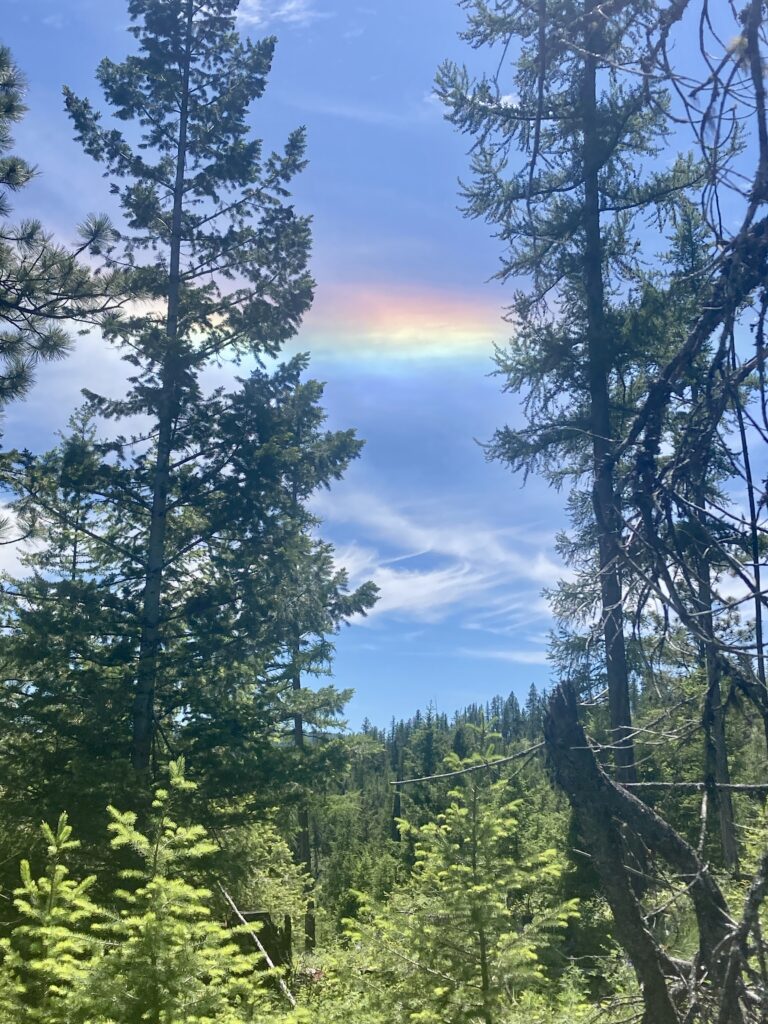
It turns out that it takes a specific kind of ice crystal to form a CHA–a flat hexagonal crystal lying horizontally. CHAs do not form close to the sun or the moon–in fact, the sun or moon must be high in the sky for CHAs to form at all. It’s the angle of the sun’s (or moon’s) light from above striking the horizontal crystals that produces the display. When the angle of the sunlight changes, the CHA dissipates. They’re quite rare, as optical phenomena go, and even when present they don’t last long. Lunar CHAs are even more rare, as they need a full moon to provide enough light to generate them. CHAs are not observable above 55˚ north or south latitudes because the sun is never high enough in the sky to generate the display. The best time to see a CHA in our valley is near the summer solstice given our 48˚N latitude, and these photos were taken just a week prior to that.
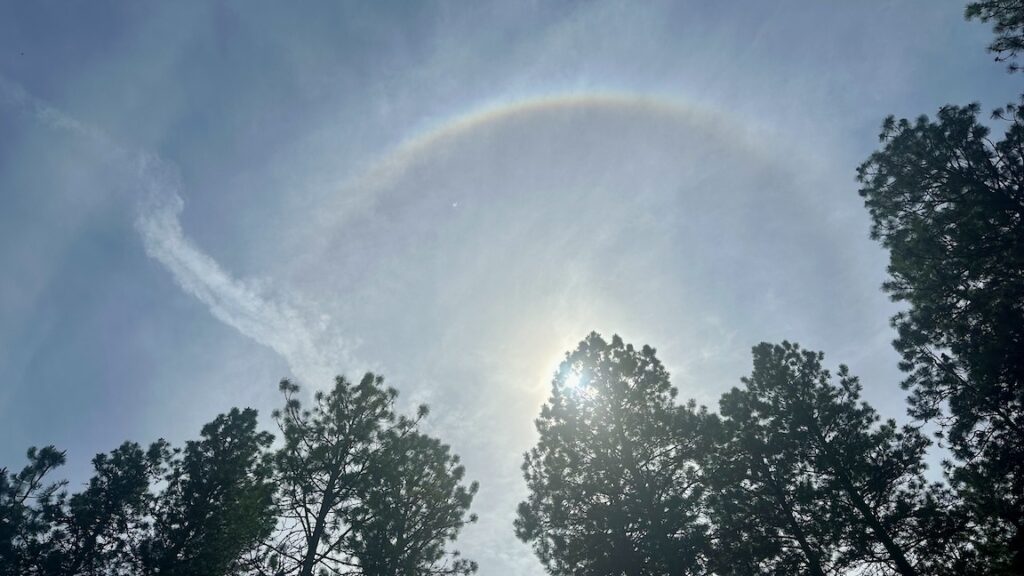
There are other kinds of ice halos that are formed under slightly different conditions. 22˚ Halos (aka sun halos, moon halos, storm halos, winter halos) form around the sun or moon from randomly dispersed ice crystals (as opposed to horizontal layers as in the case of CHAs) appearing at a roughly 22˚ radius from the sun or moon, and they typically form a complete circle around the orb. They are more common than CHAs, and were especially common during my years in Alaska when ice crystals in the air (and everywhere else) were more ubiquitous. The image below was taken near our house in the west valley in 2024.
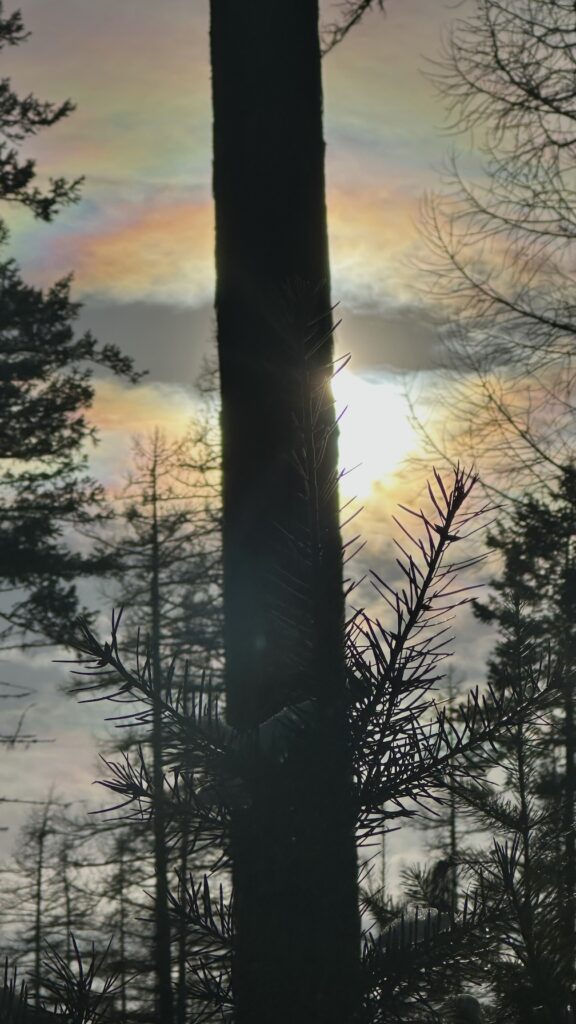
Another type of optical weather phenomenon that we see very occasionally here in the valley is cloud iridescence, formed when ice crystals or water droplets are suspended in thin clouds covering or near the run. Cloud types that produce this effect are typically altocumulus, cirrocumulus, or lenticular clouds. Unlike halos, cIoud iridescence displays can take any form or shape depending on the nature of the cloud cover. The image below was taken in Happy Valley in 2025. The sun is hidden behind the tree in the foreground.
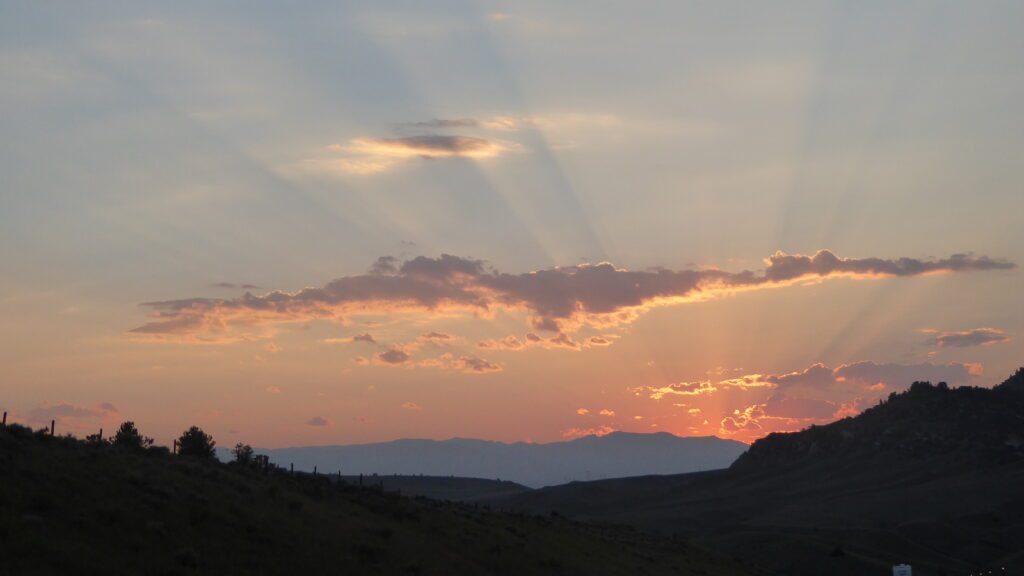
Crepuscular rays, (sometimes called “god rays” or “twilight rays”) appear at twilight (crepuscular is from the Latin “crepusculum,” meaning “twilight”) or early mornings when the sun is just below or above a cloud layer with gaps that allow sunlight to filter through. Although the rays appear to radiate from a single point, they are actually parallel to each other. We see them as converging on a single point due to our viewing perspective on the ground. Crepuscular rays occur when sunlight filters through the thicker atmosphere of twilight or early mornings and interacts with particles of dust, smoke, water, or ice that they encounter. At twilight, the rays can appear orange or red due to the scattering of shorter blue light wavelengths in the thicker atmosphere, allowing the longer red and orange wavelengths to be more visible. This phenomenon is called Rayleigh scattering.
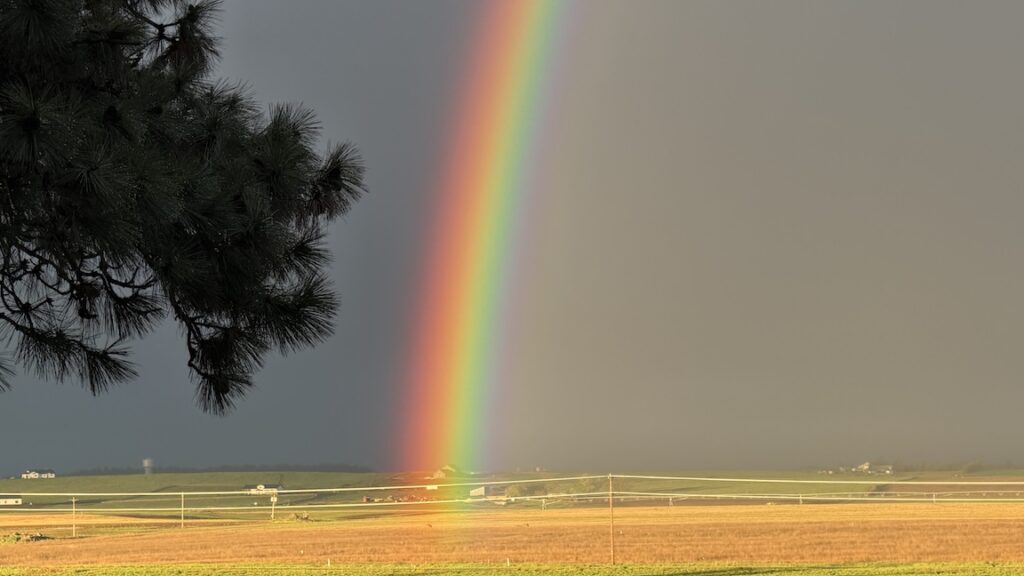
And finally, while we’re on the subject of beautiful atmospheric phenomena, here’s a particularly intense rainbow looking east from the valley to the Swan Range: