English Inquiry Project by Sawyer S., West Valley School
What is a pollinator and what positive effects do they have on us humans?
What is a pollinator? This is something one may ask themself but not truly know. A pollinator is anything that carries pollen from the stamen to the stigma. This transfer must happen for the plant to produce. From squash to wheat, this is necessary for production. When someone says pollinator, one generally thinks of bees but this is not always the case. Pollinators include wind, water, bees, wasps, moths, butterflies, birds, and even small mammals including bats.
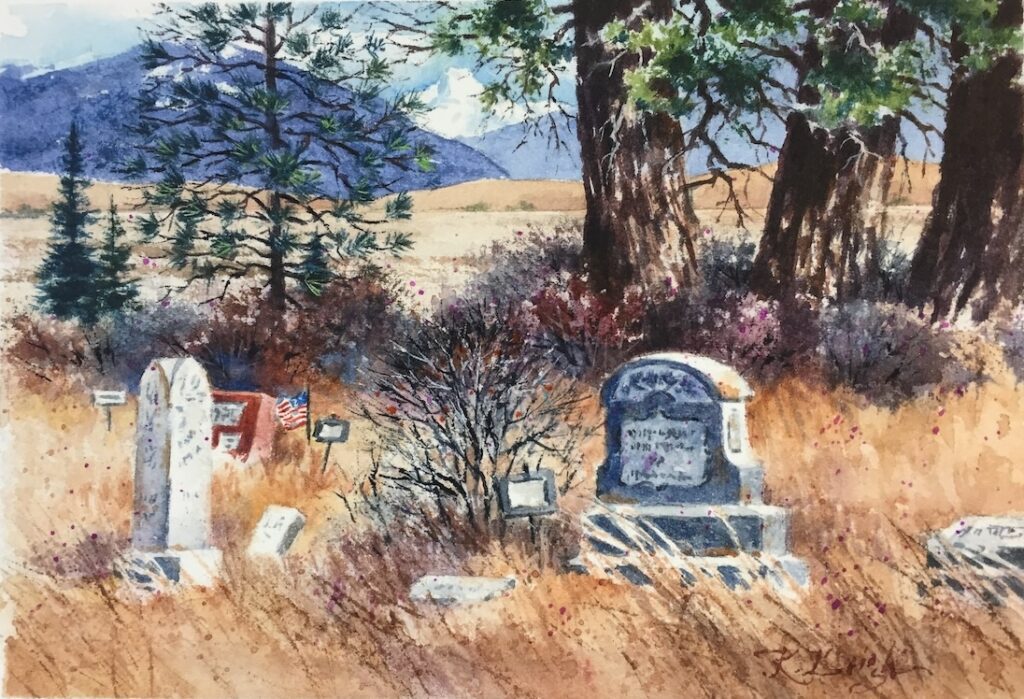
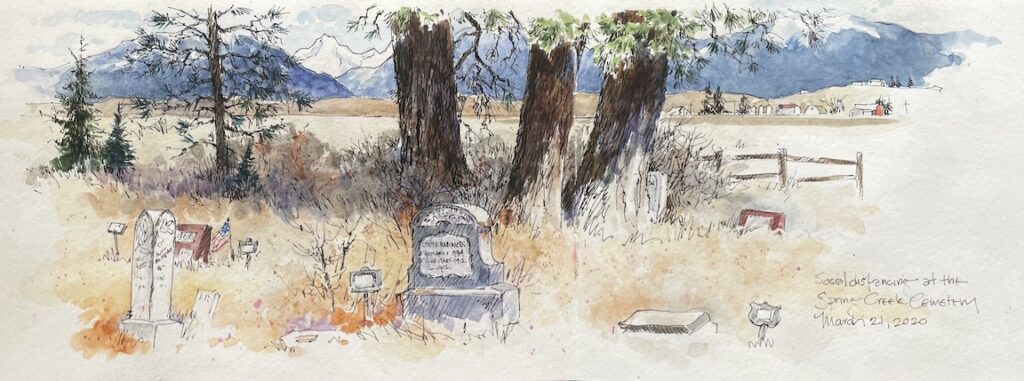
Spring Creek Cemetery is a beacon for artists. Its intriguing history and serene surroundings invite contemplation and artistic expression. During the COVID pandemic, local artist Karen Leigh found solace in sketching and painting at the cemetery. She has generously shared her sketches with West Valley Naturalists and they are presented below. Karen says there are stories to be told by each one of the markers and inscriptions. It’s inspiring to remember those who rest here and reflect on their lives of yore.
Myron Nicholson was born in Port Byron, Illinois on July 29, 1873. Mr. Nicholson spent his early years farming in Illinois. On November 25, 1900 he married Miss Emma Osborn. That same year he moved to Chicago and engaged in the manufacture of brooms. He then entered the Moody Bible Institute and became a Baptist minister. He served the church at Hubbard, Minnesota in 1903 and at Sherburn, Minnesota from 1904 until 1909 when he moved to Belt, Montana. A year later he moved to the Flathead and bought a farm five miles northwest of Kalispell. He retired from farming in 1937 and moved to Kalispell. He was a deacon of the local Baptist church and substituted as minister on many occasions.
James O’Boyle was born to Charles and Margaret O’Boyle on March 15, 1848. His father was employed by the Earl of Antrim, Hugh Seymour McDonnell (1812-1844) at the Earl’s estate in Deerpark Glenarm, County Antrim, Ireland. In 1868, at the age of 21, James set sail for New York and finding his way to Missouri for a few years. A forty-two day trip up the Missouri River brought him to Fort Benton, Montana Territory.
American three-toed WoodpeckerP.dorsalisBlack-backed Woodpecker P.arcticus
The above woodpeckers have been seen in the West Valley with increasing frequency in the last few years. To learn more about these unusual birds and why they are here, read on.
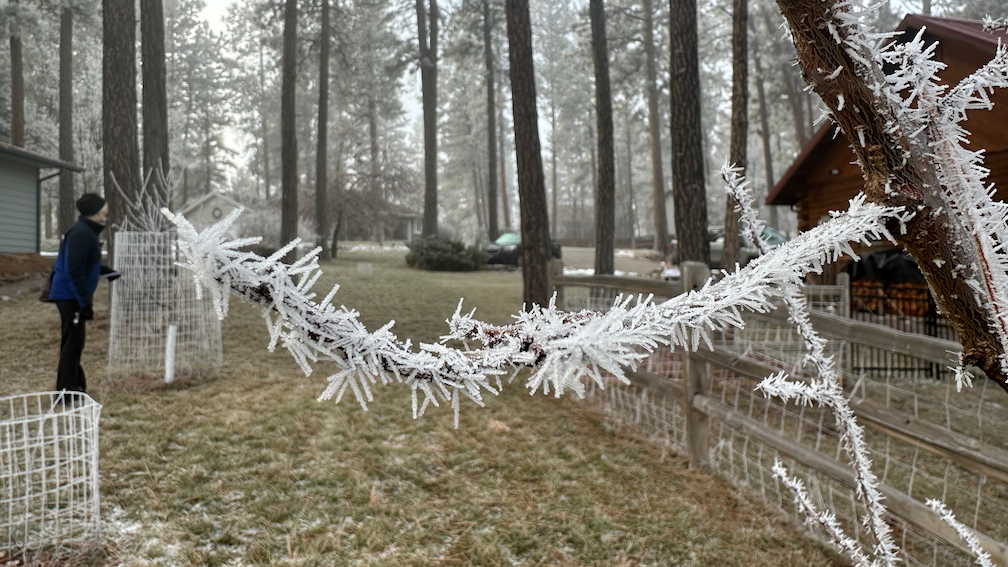
I woke up on December 29, after two days of dense fog, to see everything–leaves, grasses, fencing wire, pine needles–coated in a beautiful layer of hoar frost.
But wait…hoar frost occurs only in very specific conditions: namely cold, clear, and windless nights with low humidity, when the rapid radiant heat loss from surfaces causes water vapor–not liquid water droplets, as in fog–to form delicate, needle-like crystals on those surfaces. The previous two nights had been anything but cloudless with low humidity. You could feel the cold fog droplets on your face when you walked.
But it sure LOOKS like hoar frost. What’s going on here?
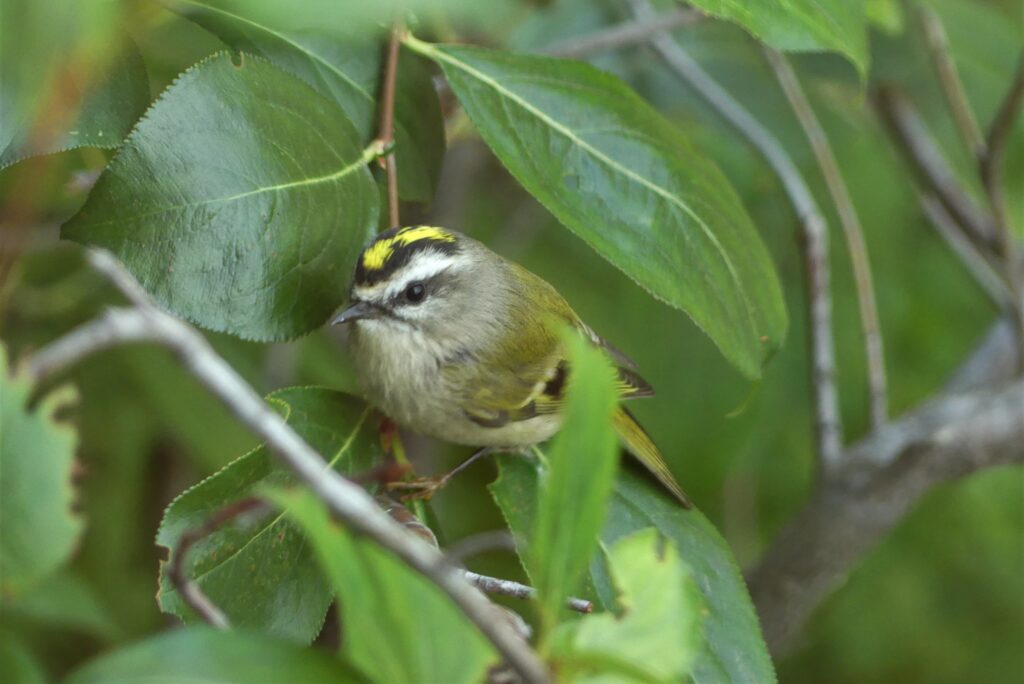
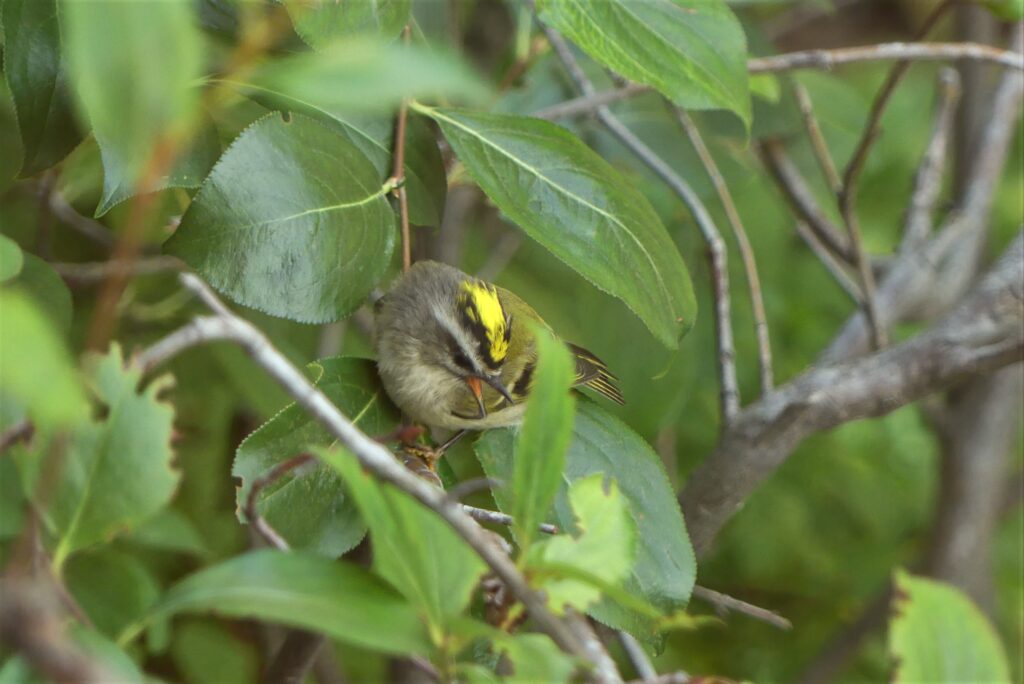
The Golden-crowned Kinglet is a permanent resident of conifer forests in our area. Regulus comes from Latin, meaning “little king”; satrapa is of Greek origin, meaning “ruler who wears a golden crown”. Males have a patch of orange feathers between the yellow, but they rarely display them. I’m assuming this one is a female, but it’s possible it’s a male in a peaceful mood!
At only a half-inch longer than our smallest bird, the Calliope Hummingbird, and weighing a mere .2 of an ounce, it’s no wonder we don’t see this little one very often. This high-energy little insectivore usually travels with others of its kind seeking food. They hover at the ends of twigs to gather microscopic mites, aphids, and aphid eggs; in summer their choice of insects is greater, and they occasionally find fruit to add to the protein sources. In winter, their most nourishing food is inchworms, the caterpillar of the geometrid moth, that they find frozen to twigs – mostly of conifers, but occasionally on maples, too.
The female Golden-crowned Kinglet constructs a hammock-like nest of moss, lichen, spider silk, rabbit hair, twigs, feathers, and other plant materials. Then she lays 8 to 11 bee-sized eggs in two layers, using her warm legs to incubate the lower layer! Usually, birds with a low success rate in raising young or migrating have big broods; Golden-crowned Kinglets’ survival challenge is overwintering in our cold climate on a low carbohydrate diet.
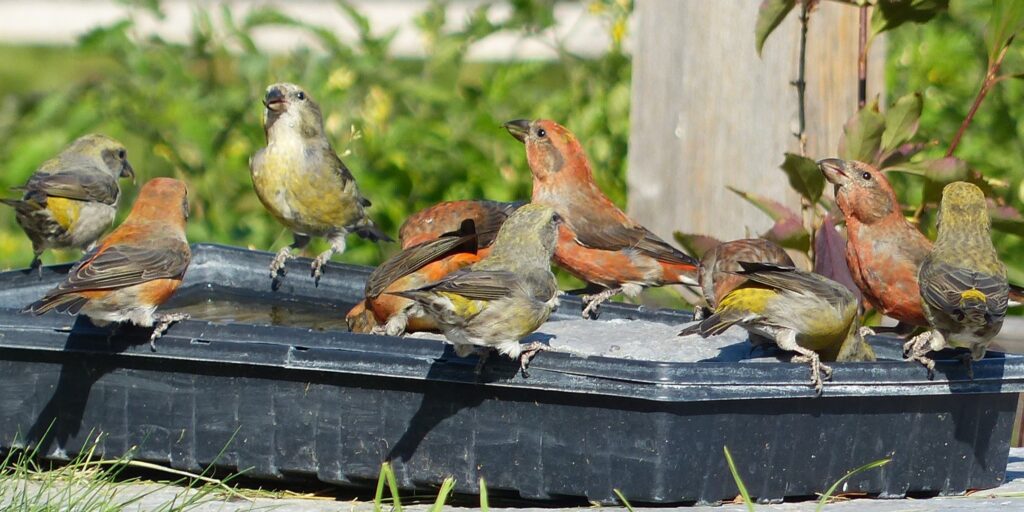
A few of the flock of Red Crossbills at their daily visit for water 10.02.2020
The only species in the world with crossed bills and many other unique traits that are under scientific scrutiny, Crossbills visit our valley sometimes during periods of heavy cone crops on our Douglas fir and Ponderosa pine trees. Though I rarely saw them feeding on cones during the summer of 2020, a flock of Red Crossbills and Pine siskins made daily visits to our yard for water. The rustle of taffeta petticoats alerted me to their arrival as they landed in the larch trees behind the water pans by the garden. The brown-striped attire of juvenile Crossbills gave me some difficulty distinguishing them from the ever-present Pine Siskins when many of them landed in the water pan at once! Read on for more about these colorful, entertaining, unique birds!
Snakes usually take us by surprise when we are walking along a path or across the lawn. They may register at first as a stick in the path, but our brain suddenly alters the message and I jump as the “stick” slithers away. Here are some different snakes I have encountered in the West Valley.
Here is a quick end-of-summer hydrology snapshot as of 9/18/23. (Compare to July 2023.)
Rainfall YTD
-3.4” from average
Flathead Lake Level
-36” (3’) from full pool
Hungry Horse Reservoir
-168” (14’) from full pool
Streamflow, Flathead River
-80 cfps from normal
Snowpack
n/a
Snowmelt
n/a
Despite a welcome August rain (21st wettest August on record) from the remnants of Cyclone Hilary, most of the Flathead Valley is still experiencing “moderate drought.” As of this writing, we’re experiencing the 6th driest year in 129 years of record keeping. Lake levels remain at historic lows. Streamflow in the North and Middle forks of the Flathead River are at “historic lows.” Streamflow in the Flathead River is somewhat mitigated by release from the Hungry Horse dam, which by regulation must maintain a minimum streamflow level for water leaving the dam. That release is causing the water level at the dam to drop.
Local lakes and ponds have benefitted from the August rain. Water levels are noticeably higher than they were in July, but are still far below average levels. Some of this increase is due to runoff, and some is due to the raising of the water table through replenishment of the shallow aquifers that underlie most of the West Valley area.
Editor’s note: In an earlier post on our website (Water Water Everywhere?) I discussed the nature of our valley water resources. Our groundwater comes from two sources–the shallow, unconfined aquifers that are replenished by precipitation, and the deeper confined aquifer from which Kalispell’s municipal water and most of the water used for irrigation in the valley is drawn. None of our water comes from reservoirs. (Whitefish gets its municipal water from Whitefish Lake.) A review of that article might provide good context for this article.
The intent of this article is intended to stimulate thought, not to advocate for a specific viewpoint. To that end, some assumptions, disclaimers and caveats:
I’m not a hydrologist, climatologist, or a geologist–just an interested observer;
Weather can change quickly in these parts;
Weather and climate are not the same thing;
I don’t know the answers to the questions I am posing.
It’s not difficult to see what a critical force water has been in the geographical and habitation history of our valley. If we didn’t have access to abundant water resources, both above and below ground, we would not be the agricultural center that we are now. And if it weren’t for glaciers, snowpack, and rushing rivers and streams, the landscape around here would look a lot different. There probably wouldn’t even be a place level enough with sufficient soil to farm at all.
Last September I put together an article–West Valley Bee and Bee–about building a bee hotel and developing a native pollinator garden around it to encourage native bees. Here’s a quick update.
My intention with this post is to begin a regular documentation of the local effects that hydrological issues have on life here in the valley.
This post from last month–Water Water Everywhere?–discusses some of the hydrological factors involved in how we access water resources for drinking and agriculture here in the valley, including a discussion of the water table and the Deep Aquifer, from which most of our water is drawn. The distinction between the water table and the Deep Aquifer is important. Rainfall, which can alter the local water table either by its presence or absence, does not affect the amount of water in the Deep Aquifer. Please refer to that article for more information.
Here’s a quick Flathead Valley hydrology snapshot from July 4, 2023:
If an enterprise or place name here in the valley doesn’t begin with “Glacier,” there’s a good chance that it begins with “Flathead.” We live in Flathead County, in the Flathead Valley drained by the Flathead River. There’s Flathead Valley Community College, Flathead High School, Flathead National Forest, Flathead Lake, the Flathead Beacon…
But where exactly does that name come from, and what does it mean? There’s a clue in the Flathead County Seal, but there is much more to the story.
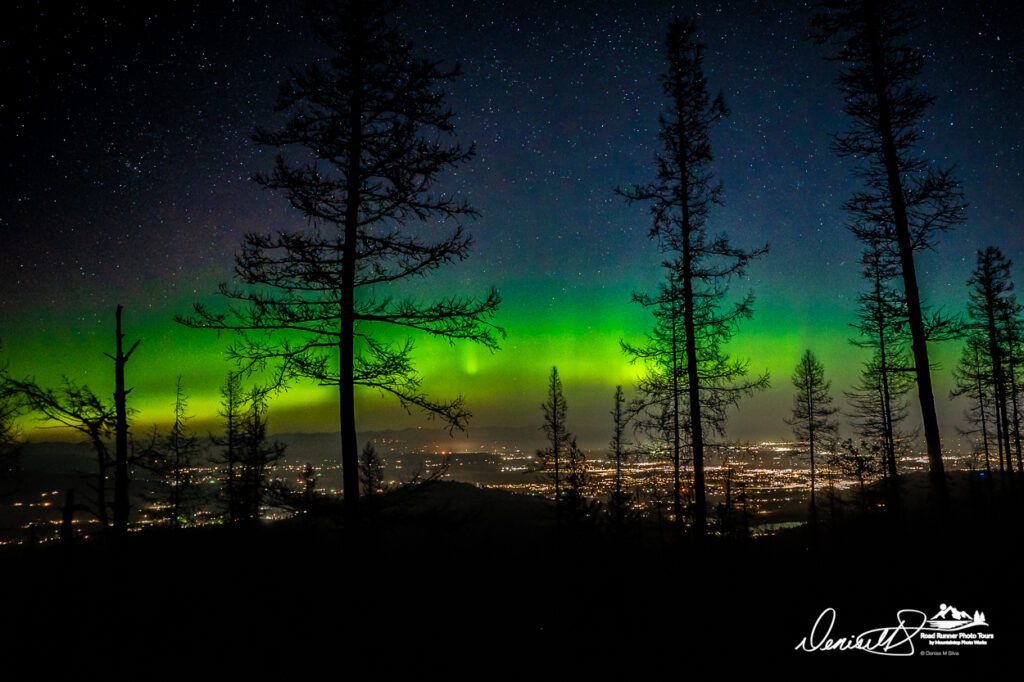
The Aurora Borealis is often referred to as the Northern Lights because we see it to our north. But this is a bit of a misnomer, as the “lights” are also seen in the Southern Hemisphere, where they are referred to as the Aurora Australis. In fact, not only does Earth have auroral displays, but auroras can be seen on images of other celestial bodies, such as Jupiter, Saturn and Mars.