The short answer: When it’s an American kestrel. The kestrel, sometimes referred to as a sparrow hawk, is actually the smallest species of falcon in North America, as well as the only type of kestrel found here. (And there is some debate over whether or not the American kestrel is a “true” kestrel.)
Spirited, social, active, acrobatic, gregarious, friendly. Maybe I should add ‘compassionate’- see the story below! Watching these little birds as they bounce along on the airwaves on their way to the bird feeder in the morning is mood-lifting. Always on the alert, head switching back and forth, they sound the first alarm when something of concern approaches.
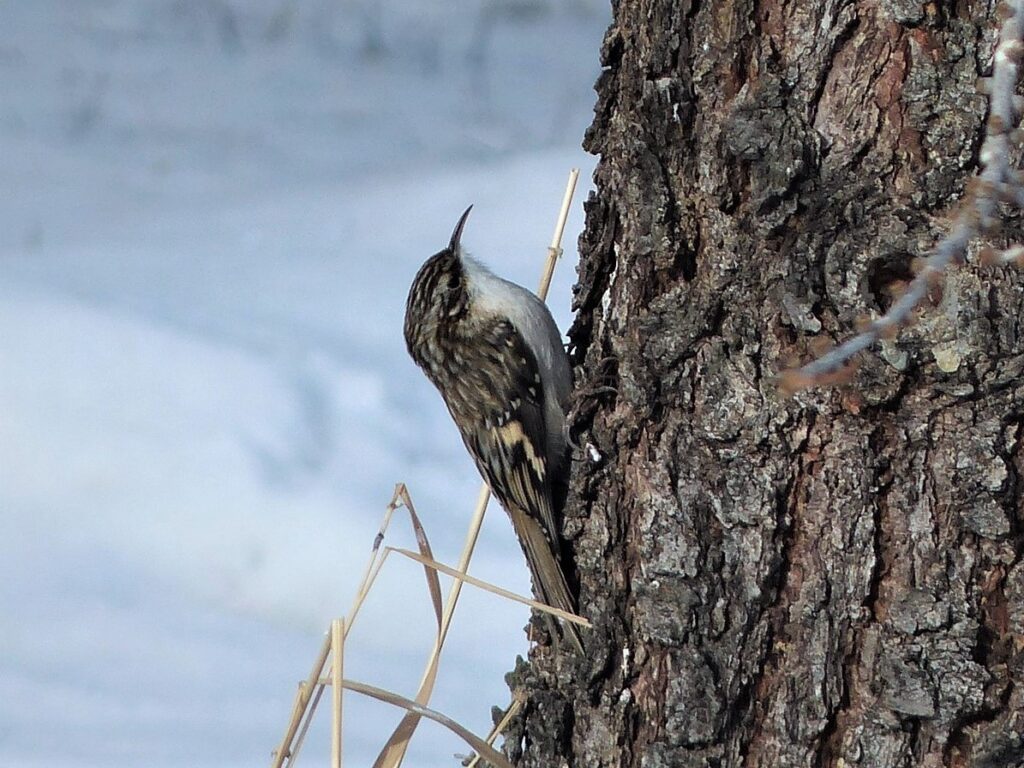
Certhia americana (Brown Creeper) on Larch tree 2.01.21
Certhia americana is the only North American member of the Certhiidae (Treecreeper) family. Thanks to its long, thin tail, it measures 5.25 inches, but it appears to be about the same size as a Pygmy nuthatch, with which it could be confused. “A prisoner of the forest, the creeper seems unable to escape the gravitational pull of the tree trunk on which it creeps, ever upward” writes Bryan Pfeiffer. They live in mature coniferous forests, not wandering far afield.
Pat Jaquith’s wonderful post about nuthatches reminded me of how much I enjoy watching them. We have several bird boxes around our house, and pygmy nuthatches will regularly occupy two specific boxes–and, as you’ll see in the videos below, this can lead to some territorial issues.
White-breasted Nuthatch browsing the bark headfirst 4.27.16
We hit the jackpot on Nuthatch species– well, almost! Three of the four Nuthatch species in the US live here! We have Red-breasted, White-breasted, and Pygmy Nuthatches. While each has a favored tree species, our mixed forests are great places to see all of them. Nuthatches grab a seed, wedge it into a bark crevice and hammer it open as if using a hatchet – thus, their curious name! They are well-equipped for gleaning insects and seeds from all directions. Their clawed feet hook into bark providing sure traction as they cruise up, down, and around looking for food. While our environment provides everything they need, they are frequent visitors to bird feeders, gardens, and water holes, making even more opportunities to observe their acrobatic talents.
Members of the Orchidaceae (Orchid) family, there are several species of Coral roots that grow in our valley. In this article, I will introduce the ones I have seen.
Winter is a good time to spot unusual things when the leaves are off and grasses are dry and beaten down by snow. Sometimes it just takes a splash of color that you wouldn’t expect to draw your attention to an unusual growth. The galls in this article all are caused by different insects but are benign, that is, they usually don’t harm the plant they are on.
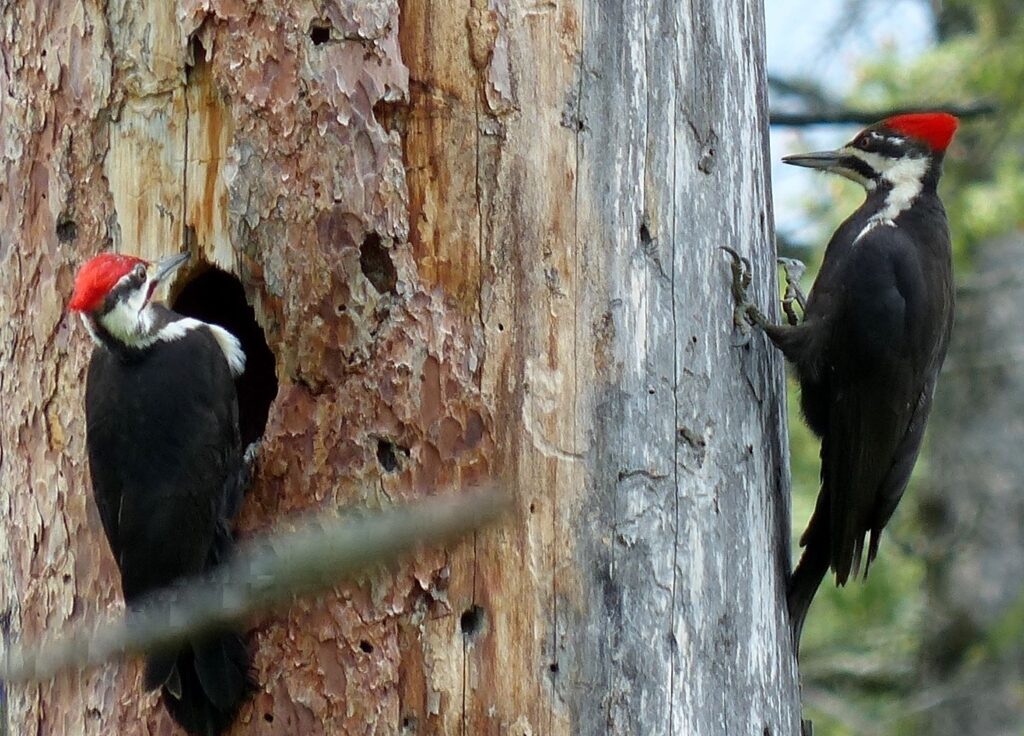
Skip’s journal post about Pileated Woodpeckers inspired me to add a few more images and some of my observations of these unforgettable birds that the American Birding Association has named the 2021 Bird of the Year.
Pat Jaquith’s lovely Winter Wonders post prompted me to post these images taken on 1/7/21 at the Happy Valley State Trust Lands (see Locations) after a light snow melt on a bluebird afternoon.
Pileated woodpeckers are the largest woodpeckers in North America. (The ivory-billed woodpecker of the southeastern US swamps and marshes is larger, but it is considered “definitely or probably” extinct.) While pileated woodpeckers are not exactly rare in the valley–I’ve encountered them year ’round in the Happy Valley State Trust Lands and the Pig Farm State Trust Lands (see Locations)–they are infrequent visitors to areas of the valley with fewer trees and more houses. That’s why it’s such a rare treat to see one in the back yard.
Editor’s note: Pat Jaquith came across a barn wood reclamation team dismantling an old pump house on Spring Creek Road. Pat contacted Jeanine Beuttner for more information and learned that this property was established by Jeanine’s great grandparents, Charles and Rosalia Keller. Jeanine graciously offered us this fascinating historical vignette.
The Dec 24 2020 edition of the Daily Interlake has a useful downloadable supplement (by Scott Heisel of the Lake County Leader) on winter birding day trips in the Flathead Valley and beyond. It’s a little difficult to locate, so if you missed the print edition, here is a PDF file of the article.
One of my passions is wildflowers, but the growing season of wildflowers is pretty short here in the West Valley. I have turned to lichens to help fill the void in colder months; it’s a fascinating venture. Neither plant nor animal, lichens are plentiful around here. One source reports there being 2500 species in the Pacific Northwest. Fossil records date them as long as 400 million years ago. Lichens can be found on the ground, on rocks, and on trees – both decaying and healthy. When you go out looking at lichens, I strongly recommend taking a hand lens because some of their most interesting features are almost microscopic!